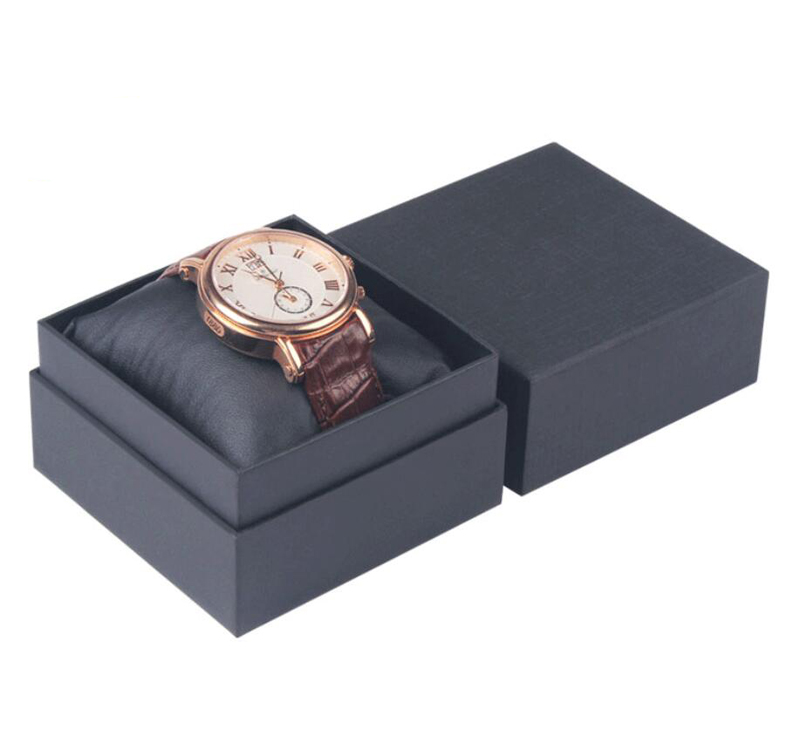
A watch brand out of Miami sent us their competitor’s box last February — a microbrand diver they were benchmarking against — and asked why that box “felt like $800” when the watch inside retailed at $320. We cut it open on the QC table. The outer shell was standard 1200 GSM greyboard wrapped in 157 GSM art paper, nothing special. The pillow insert was where the money sat: hand-stitched leatherette wrapped over dual-density foam, with a 42 mm circumference calibrated to their specific strap. The logo was blind-embossed on the inside lid, not foiled on the front. Total incremental cost over a generic watch box: maybe $1.80 per unit. Perceived value lift: three to four times that.
The pillow insert, the leather texture, and the logo placement decide whether a custom watch box reads as premium or generic. This guide breaks down what actually drives that perception and what each choice costs.
Quick Answer Up Front
A custom watch box runs $2.80–$8.50 FOB Guangzhou at MOQ 500 pcs, with lead times of 15–22 days after artwork approval. The pillow insert — usually a foam core wrapped in PU leather, microfiber suede, or velvet — is the single biggest driver of unboxing feel and represents 20–35% of unit cost. Outer construction is typically 1500 GSM greyboard wrapped in 128–157 GSM art paper or textured specialty paper. Samples ship in 5–7 days via DHL or FedEx.
What the Pillow Insert Actually Does — And Why It Gets Specced Wrong
The pillow is the curved cushion the watch wraps around. Its job is mechanical before it’s aesthetic: it holds the strap in a natural open position so the watch face stays visible, it prevents the case from rattling during FedEx Ground transit, and it gives the buyer something to grip when lifting the watch out. Get the circumference wrong by even 5 mm and the strap either droops or strains, neither of which photographs well on Instagram.
We make pillows three ways at our Guangzhou factory. Single-density foam wrapped in fabric is the entry point — we die-cut 30-density EVA into a cylinder, wrap it in microfiber or velvet, and glue the seam on the bottom. Cheap, works fine for straps under 22 mm. Dual-density foam uses a firmer 45-density core with a softer 25-density outer layer, giving a pillowy surface that doesn’t collapse under a heavy diver. Hand-stitched leatherette sleeves wrap the foam in PU or PVC leather with visible saddle stitching — this is what luxury microbrands use.
The wrong pillow kills a good box. A 40 mm pillow under a 44 mm strap leaves visible slack and makes the watch look oversized for its box. A 48 mm pillow under a 40 mm strap stretches the leather flat. Always spec pillow circumference to match your most common strap size, not an average. You can see the full pillow and insert range across our watch boxes product line.
How Leather Texture Changes the Room
The outer wrap material sets the tone before the lid opens. Five textures cover roughly 90% of what we produce for watch packaging boxes, and each one signals something different to the buyer.
| Material | Feel | Typical Use Case | Cost Add vs. Baseline |
|---|---|---|---|
| 128 GSM art paper, matte laminate | Smooth, paper-like | Fashion watches $80–$200 | Baseline |
| Textured specialty paper (linen, hammered) | Subtle tactile grain | Heritage/vintage brands | +$0.15–$0.30/pc |
| PU leather wrap (saffiano, pebble) | Grained, structured | Field and pilot watches | +$0.60–$1.20/pc |
| Microfiber suede | Soft, matte, warm | Dress watches, jewelry-adjacent | +$0.45–$0.80/pc |
| Full-grain PU with stitched edges | Premium, hand-crafted feel | Luxury microbrands $400+ | +$1.40–$2.60/pc |
H3: Pebble vs. Saffiano vs. Smooth — What Actually Wears Well
Saffiano has a cross-hatched texture that hides scratches and fingerprints. Pebble grain is softer-looking but shows wear around edges after 6–12 months of shelf time. Smooth leather photographs best but scratches during shipping unless the box is cello-wrapped. If your boxes sit on retail shelves, go saffiano. If they ship direct to consumer in a padded mailer, pebble or smooth both work.
H3: Why Pantone Matching on Textured Paper Is Harder Than It Looks
Textured paper absorbs ink unevenly. A Pantone 7540 C (deep charcoal) on smooth art paper prints clean; on linen-textured paper it can shift 2–3 ΔE darker because ink pools in the grain. We build a 2–3 day color-matching loop into every textured-paper job. If your designer hasn’t printed on that stock before, expect one round of sample revision.
How to Decide Which Watch Box Fits Your Brand
Three questions settle most of this before we quote.
What’s the retail price band? A $150 quartz fashion watch sells best in a folding or semi-rigid box at $2.80–$3.50 per unit. A $450 automatic lives comfortably in a rigid box with PU leather wrap at $5.50–$6.80. A $1,200 microbrand diver needs hand-stitched leatherette and blind embossing, landing at $7.50–$8.50.
Where does the box end up? DTC buyers who get the box in a mailer treat it as a keepsake — spend on the insert and the interior finish. Retail customers see only the exterior on shelf — spend on the outer wrap and shelf-visible logo. Corporate gift buyers care about the lid graphics because that’s what the recipient photographs.
How often will you reorder? Brands doing one run of 500 pcs per year should avoid custom dielines with expensive tooling. Brands running 2,000+ pcs every quarter can amortize a custom magnetic-drawer design across 8,000+ units, bringing per-unit cost down meaningfully.
Many brands at the $300+ price point land on a premium drawer-style or magnetic flip design. Our custom watch box for premium packaging is a spec we’ve produced for roughly two dozen microbrands — rigid construction, PU leather exterior, dual-density foam pillow, magnetic closure with a 180-degree lid action. The interior satin lining adds about $0.40/pc but lifts the unboxing feel noticeably on video.
Where Your Logo Should Actually Go
Logo placement is where brand managers and packaging buyers argue most. The default instinct is “biggest possible logo on the front of the lid.” It’s usually wrong for premium positioning.
Watch brands that photograph well place their logo in one of three spots, and almost never all three at once. Center-front on the lid, embossed or debossed without foil, reads as confident and old-money. Blind embossed on the inside lid — visible only when the box opens — creates a small reveal moment and photographs well on unboxing video. Debossed on the pillow leather itself is the most premium placement and the most expensive; it requires a separate debossing die for the insert, adding $180–$240 in tooling plus $0.25/pc in processing.
Cost Snapshot — Rigid Watch Box, MOQ 500, 110×110×85 mm
- 1500 GSM greyboard + 128 GSM art paper wrap: base $3.20/pc
- PU leather exterior upgrade: +$0.90/pc
- Dual-density foam pillow with microfiber cover: +$0.65/pc
- Magnetic closure (2 pcs neodymium): +$0.20/pc
- Gold foil logo on lid exterior: +$0.30/pc
- Blind embossing on inside lid: +$0.18/pc
- Satin interior lining: +$0.40/pc
- Total: $5.83/pc FOB Guangzhou
At 1,000 pcs the per-unit drops to around $5.15. At 3,000 pcs, roughly $4.60. The rigid box construction we use here follows the same principles covered in our guide on what is a rigid box: types, materials, uses explained if you want the deeper structural breakdown.
Common Mistakes We See Buyers Make
Five patterns repeat across first-time watch gift box orders.
- Ordering the pillow before finalizing the watch strap supplier. Strap leather thickness varies 1.5–3.5 mm between suppliers. A pillow sized for a 2 mm strap looks wrong with a 3 mm strap. Lock your strap spec first.
- Using CMYK for metallic brand colors. CMYK can’t reproduce metallic gold or silver. If your brand color is a metallic, spec Pantone Metallic or add foil stamping. Expect $80–$120 in spot color setup per color.
- Specifying full-grain leather without understanding the budget. Real leather on a watch box doubles the unit cost and adds 8–10 days to lead time due to hide sourcing. PU leather reads identically in photos at 1/4 the cost.
- Skipping the pre-production sample to save a week. Every single client who skips this step calls us three weeks later about a color or embossing issue. Budget the 5–7 days.
- Ordering exactly 500 pcs on a foiled or embossed job. Production defect allowance is roughly 2% on complex finishing. Order 520–540 to land at 500 sellable units.
Ready to Spec Out Your Watch Box?
Send us your watch dimensions, strap width, rough quantity, and any reference photos — that’s enough to start. We’re a factory, not a middleman. Bobst die-cutters and Heidelberg CD102 presses run in our Guangzhou facility, MOQ is 500 pcs, samples ship in 5–7 days via DHL, and dieline mockups are free with every quote. If you’re still deciding between a magnetic flip and a drawer-slide design, send photos of your watch and we’ll recommend the pillow structure that fits.