Last Tuesday afternoon our CAD team was halfway through a dieline for a Brooklyn jewelry:A jewelry brand from Brooklyn walked into our showroom last October with a complaint we hear maybe twice a month: their $180 tennis bracelets kept arriving to customers with the chain tangled around the pendant, and return rates were climbing past 9%. The boxes themselves were fine — 1200 GSM rigid construction, magnetic closure, clean foil logo. The problem sat inside. They’d been using a single-slot EVA insert meant for a ring, forcing a bracelet into a cavity that let it shift during FedEx ground transit. We redesigned the insert with a velvet-wrapped channel and two retention clips. Returns dropped to 1.8% within six weeks.
Inserts are the part most buyers underestimate when sourcing a custom jewelry paper box. This guide walks through insert materials, how to match structure to price tier, and the decisions luxury brands make differently — so you can spec a box that actually protects what’s inside.
Quick Answer Up Front
A custom jewelry paper box usually costs $1.80–$5.80 FOB Guangzhou at MOQ 500 pcs, with lead times of 20-25 days after artwork approval. The insert — EVA foam, velvet-wrapped sponge, or molded pulp — accounts for 15–30% of the total unit cost and is the single biggest driver of perceived quality. Paper grade (typically 157 GSM art paper wrapped over 1200GSM greyboard) sets the outer feel. Samples ship in 5–7 days via DHL or FedEx.
What Goes Inside a Jewelry Paper Box — Materials That Actually Matter
The outer shell of a jewelry packaging box gets most of the attention in pitch decks, but the insert does the heavy lifting. There are four insert materials we run through our factory regularly, and each one tells a different story at unboxing.
EVA foam is the workhorse. Dense, shock-absorbing, cuts cleanly on a CNC router. We use 35–45 density EVA for rings, earrings, and pendants. It holds shape after thousands of open-close cycles, which matters if the buyer keeps the box as a storage case.
Velvet-wrapped sponge is what most luxury brands specify. A 3–5 mm sponge core gets hand-wrapped with microfiber velvet (usually in navy, black, or cream), then slotted into the rigid box cavity. The tactile difference versus bare EVA is immediate — velvet has a slight nap that catches light, and it doesn’t squeak against metal jewelry.
Molded pulp is the sustainability play. FSC-certified, recyclable, and increasingly requested by DTC brands targeting Gen Z buyers. The tradeoff: pulp has a raw texture that reads “eco” more than “luxury.” It works for $40–$120 price points, less so for $500+ fine jewelry.
Microfiber-lined plastic trays sit in the middle. Vacuum-formed PET with a flocked lining, cheap to produce at scale, but the seams show under good lighting.
For fine jewelry, rigid construction with velvet inserts is the baseline. You can browse our full range of jewelry packaging boxes to see how these materials pair with different box formats.
How to Match Insert Structure to Your Price Tier
The mistake I see most often is buyers choosing an insert based on what looks good in a reference photo, without checking whether it fits their retail price point. A $38 stud earring doesn’t need a die-cut leatherette tray. A $2,400 engagement ring shouldn’t arrive in vacuum-formed plastic.
Here’s the rough mapping we use when quoting:
| Retail Price | Recommended Insert | Typical Box | Unit Cost (MOQ 500) |
|---|---|---|---|
| $20–$80 | Die-cut EVA, single or double slot | Folding box, 250 GSM art paper | $0.85–$1.60 |
| $80–$250 | EVA with spot-UV printed top layer | Drawer box, 1000 GSM greyboard | $1.80–$2.80 |
| $250–$800 | Velvet-wrapped sponge, magnetic closure | Rigid box, 1200 GSM greyboard | $2.80–$4.20 |
| $800–$3,000 | Velvet tray + satin ribbon retention | Book-style rigid box, 1500 GSM | $4.20–$5.80 |
| $3,000+ | Hand-stitched leatherette, brass hardware | Custom rigid with drawer system | $6.50–$12.00+ |
Why Ring Boxes Need Different Geometry Than Pendant Boxes
Rings need vertical clamping — a slot that grips the band. Pendants need horizontal layout with a chain channel so the chain doesn’t tangle under its own weight during shipping. Earrings need two anchor points. Bracelets need either a curved channel or a center post with retention wings. If your supplier is quoting the same insert for all SKUs, that’s a flag.
H3: Foam Density Matters More Than You Think
A 25-density EVA foam feels soft but deforms within 200 open-close cycles. A 45-density foam stays rigid for 2,000+ cycles. The cost difference is $0.04–$0.08 per insert. Always specify density, not just color.
How to Decide Which Structure Fits Your Brand
Three questions decide this, and I ask every new client the same ones before we quote.
What’s the unit economics tolerance? If your product lands on Shopify at $95 with a 62% gross margin, you can absorb $2.80 in packaging. If it’s $45 with a 40% margin, the box budget is closer to $1.20, and velvet wrap is off the table.
Where does the box end up after unboxing? Fashion jewelry buyers toss the box within a week. Fine jewelry buyers keep it. If the box is a keep-forever item, invest in the hinge mechanism and insert longevity. If it’s disposable, spend on the printed exterior instead.
What’s the shipping environment? A box going out via USPS First Class in a bare mailer bag gets more abuse than one shipped in a padded mailer with dunnage. Our rigid boxes pass ISTA 3A drop testing as standard, but the insert grip is what keeps the product from rattling inside.
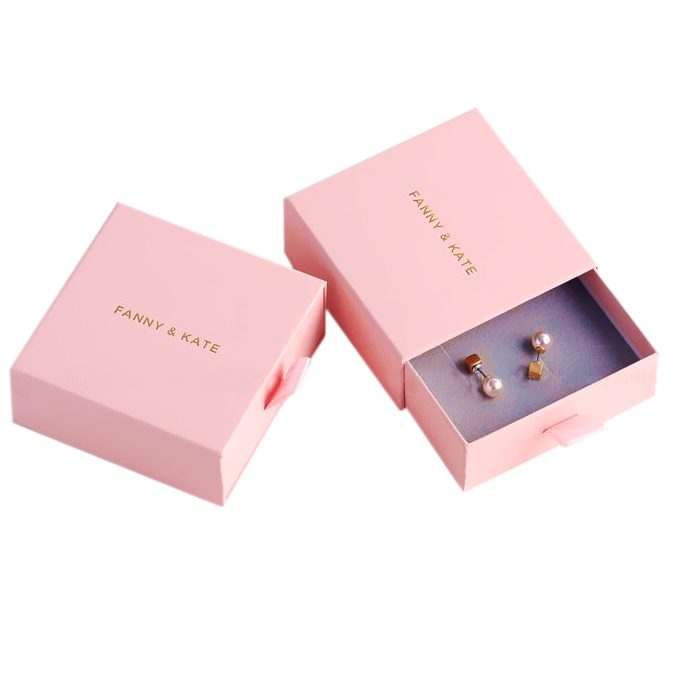
Brands selling at the $300+ price point usually land on a drawer-style rigid box with a sliding tray. The OEM custom luxury paper sliding jewelry gift box is one of our most-repeated specs — the drawer mechanism gives a slow reveal moment that photographs well for Instagram unboxing content, and the velvet insert can be swapped between SKUs without retooling the outer sleeve.
Cost and Lead Time Reality Check
Here’s what the numbers actually look like when you place an order with us.
Cost Snapshot — Rigid Jewelry Box, MOQ 500, 100×100×40 mm
- 1200 GSM greyboard + 157 GSM art paper wrap: base $2.20/pc
- Add 4-color offset printing (Heidelberg CD102): +$0.30/pc
- Add gold foil stamping (logo area ≤ 25 cm²): +$0.25/pc
- Add velvet-wrapped sponge insert: +$0.55/pc
- Add magnetic closure (2 pcs neodymium): +$0.20/pc
- Total: $3.50/pc FOB Guangzhou
At 1,000 pcs the per-unit cost drops roughly 12%. At 3,000 pcs, another 8–10%. The real cost break happens past 5,000 pcs where we can move the job from our semi-automatic box-wrapping line to full automation.
Lead times break down like this:
- Dieline confirmation: 1–2 days
- Pre-production sample (digital print): 5–7 days
- Pantone color matching and approval: 2–3 days
- Mass production after approval: 15–22 days
- Ocean freight Guangzhou to LA: 18–25 days
- Ocean freight Guangzhou to NY/NJ: 28–35 days
- Air freight DHL/FedEx for urgent orders: 3–5 days
If you’re planning for a holiday launch, back-calculate from your in-warehouse date. A Thanksgiving launch means artwork locked by mid-September at the latest.
Common Mistakes We See Buyers Make
Six patterns come up in almost every first-time order. I’ll list them plainly.
- Sending a CMYK file for a Pantone-specific brand color. A Seattle fine jewelry client specified Pantone 876 C (metallic gold) in their brief but submitted a CMYK mockup. The first sample came back looking mustard. Always send Pantone codes for brand colors, and expect a small upcharge ($80–$120) for spot color setup.
- Skipping the pre-production sample. Digital samples cost $60–$150 and add a week. Every buyer who skips this step ends up with a color variance complaint at mass production. Every single one.
- Specifying soft-touch lamination on a foil-stamped box without checking sequence. Foil on top of soft-touch film blisters in humid shipping conditions. Sequence must be: print → foil → laminate, never the other way around.
- Underestimating the insert cavity tolerance. Jewelry dimensions vary by ±0.5 mm from piece to piece. If your cavity is cut to exact spec, 1 in 8 pieces won’t fit. We cut cavities with 1.5–2 mm tolerance as standard.
- Choosing ribbon closures for international shipping. Ribbons fray in transit. Magnetic closures or tuck-tab systems hold up better through ocean freight and last-mile delivery.
- Ordering at exactly MOQ 500 for the first run. Always order 520–550 pcs. Production has a ~2% defect allowance on foiled or embossed jobs. You want the extras.
For brands moving into the luxury tier, our luxury rigid box design ideas post covers the structural choices — book-style vs. drawer vs. magnetic flip — that separate a $4 box from a $12 box.
Ready to Spec Out Your Jewelry Box?
If you’ve got dimensions, a Pantone number, and a rough quantity in mind, that’s enough to start. We’re a factory, not a trading company — the Bobst die-cutter and Heidelberg presses are in our Guangzhou facility, not outsourced. MOQ is 500 pcs, samples ship in 5–7 days via DHL, and free dieline mockups come standard with every quote request. If you’re still deciding between drawer-style and magnetic closure, send photos of your jewelry pieces and we’ll recommend the insert structure.