
Many e-commerce brands discover dimensional weight the expensive way: a light product ships in a roomy box, the invoice arrives, and the freight cost is far higher than expected. The product did not get heavier. The box did not get bigger in transit. What changed the price was the space the box occupied — and carriers charge for that space through dimensional weight.
This guide explains how dimensional weight works from a packaging manufacturer’s point of view, and — more importantly — what you can actually do about it at the box-design stage. Because once the box exists, the freight math is already decided.
What Is Dimensional Weight (and Why Carriers Use It)
Dimensional weight — often shortened to DIM weight — is a pricing method used by parcel carriers (courier and express companies) to account for the space a package takes up, not just how heavy it is.
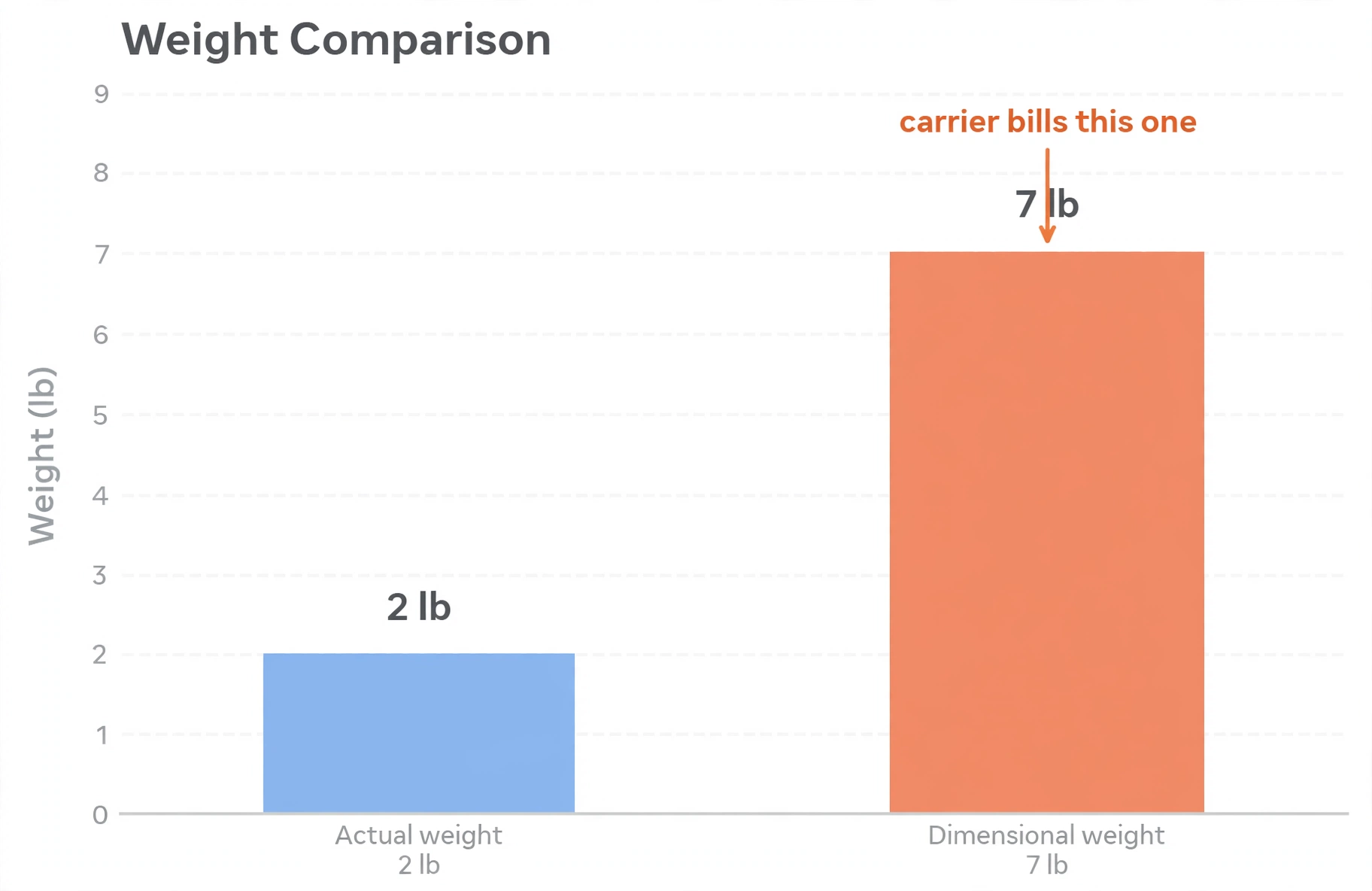
The logic is straightforward from the carrier’s side. A delivery van or cargo aircraft fills up by volume long before it reaches its weight limit. A box of pillows and a box of books can weigh very differently while occupying the same space in the truck. If carriers priced purely by actual weight, low-density shipments would consume valuable cargo space at bargain rates. DIM weight corrects that: it converts a package’s volume into a weight equivalent, and the carrier bills whichever is greater — actual weight or dimensional weight.
This matters most for:
- Light but bulky products — apparel, pillows, plush toys, empty-space-heavy gift sets
- E-commerce parcels shipped by courier or express, where DIM pricing is standard
- Oversized boxes with generous empty space around the product
If your product is dense and heavy (a bottle of olive oil, a metal tool), actual weight usually wins and DIM weight rarely surprises you. If your product is light relative to its size, DIM weight is probably the number that sets your freight bill — and the box dimensions are what set that number.
How Dimensional Weight Is Calculated
The formula itself is simple. Carriers measure the package’s three outer dimensions and divide the volume by a fixed number called the DIM divisor (sometimes called the DIM factor):
Dimensional weight = (Length × Width × Height) ÷ DIM divisor
A few things worth knowing about each variable:
- Dimensions are the outer measurements of the finished, sealed package, in inches or centimeters depending on the carrier. They include the full height of the closed box — not the product inside.
- The DIM divisor is set by each carrier, and it differs between domestic and international services. A common domestic divisor used by major US carriers is 139 (cubic inches per pound), but you should always confirm the current divisor with your specific carrier and service level before doing the math. Divisors change; assumptions do not age well.
- The result is compared against actual weight. The carrier charges based on the billable weight — whichever figure is higher.
In plain terms:
- Weigh the sealed package → actual weight
- Calculate (L × W × H) ÷ divisor → dimensional weight
- Billable weight = the greater of the two
That third step is where the surprise lives. A 2 lb product in a large box can easily bill at 7 or 8 lb.
Worked Example: From Box Dimensions to Billable Weight
Let us walk through the calculation with example dimensions so the mechanics are clear. Suppose you ship a lightweight apparel item in a custom mailer box measuring 12 × 10 × 8 inches, and the sealed package weighs 2.5 lb on the scale.
Step 1 — Volume:
12 × 10 × 8 = 960 cubic inches
Step 2 — Dimensional weight (using a divisor of 139 as an example — confirm your carrier’s current figure):
960 ÷ 139 ≈ 6.9 lb
Step 3 — Billable weight:
Actual weight: 2.5 lb. Dimensional weight: 6.9 lb. The carrier bills 6.9 lb (rounded per the carrier’s rounding rules).
Now suppose the same product ships in a right-sized mailer measuring 12 × 10 × 4 inches:
12 × 10 × 4 = 480 cubic inches → 480 ÷ 139 ≈ 3.5 lb
Billable weight drops from roughly 6.9 lb to roughly 3.5 lb — for the identical product, simply because the box is 4 inches shorter in height. Multiply that difference across thousands of monthly shipments and the box dimension becomes one of the largest controllable variables in your freight budget.
No freight rates are quoted here on purpose: carrier pricing changes by lane, service, fuel surcharge, and contract. But the mechanism is constant — smaller billable weight means a lower freight bracket, whatever your rates are.
How Box Size Quietly Inflates Your Shipping Bill
In practice, DIM overcharges rarely come from one dramatic mistake. They accumulate from ordinary packaging decisions:
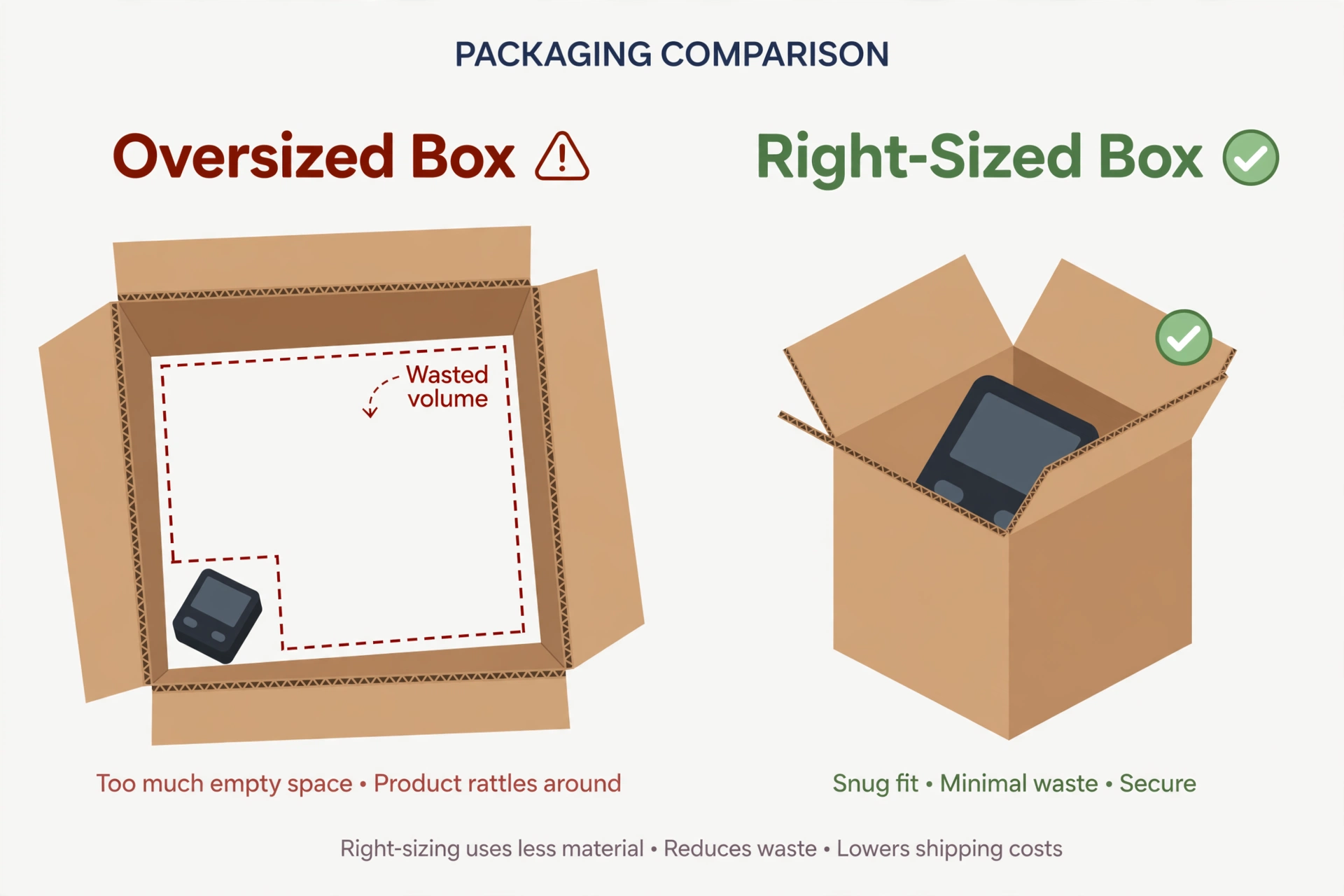
Oversized “one size fits all” boxes. Brands often standardize on two or three box sizes to simplify inventory. The convenience is real — but every product shipped in a box one size too large pays DIM weight on empty air. This is the single most common source of inflated parcel freight we see.
Excessive void space. Even a correctly sized box can bill badly if the product rattles around inside half-empty space. Void fill (tissue, honeycomb paper, air pillows) protects the product, but it does not reduce the outer dimensions — and the carrier only measures the outside.
Thick boxes for light products. An unnecessarily tall box — chosen “to be safe” — is the most expensive kind of caution. Height is usually the easiest dimension to trim without touching the product footprint.
Ignoring the sealed package. Buyers sometimes calculate DIM from the flat box dimensions on a spec sheet. Carriers measure the sealed, bulging, taped package. A box that bulges half an inch in each direction after packing bills on the larger number.
The pattern: every dimension decision made at the packaging design stage becomes a freight decision at the shipping stage. That is exactly why a packaging manufacturer belongs in the conversation before you lock your box size.
What a Packaging Factory Can Do About It
We are not a logistics company, and this is not freight advice. Our side of the equation is the box itself — and there is a surprising amount a factory can do to bring your billable weight down before a single parcel ships.
Right-sizing the box to the product. This is the highest-impact move. A manufacturer works from your product dimensions and builds the mailer around them — length, width, and especially height — with just enough clearance for the insert and closure. Our mailer box size guide walks through how those clearances are set. Cutting two inches of unnecessary height across a monthly volume is often worth more than any freight negotiation.
Choosing the right mailer structure. Roll-end-tuck-front (RETF) mailers, for example, close flat and hold their dimensions precisely, which keeps the sealed package close to the spec-sheet size. Structures that bulge or close unevenly add phantom inches the carrier will happily measure.
Reducing void at the design stage. Instead of filling empty space with void fill after the fact, the box can be designed so there is less empty space to begin with — through right-sized dimensions, fitted inserts, or multi-depth (scored) mailers that fold down to the product height. An insert that holds the product snugly does double duty: protection and dimension control.
Flat-pack structures for rigid boxes. For gift-ready rigid packaging, foldable rigid boxes ship flat and assemble before use, so far more units fit into each export carton. That addresses a different leg of the journey — factory-to-warehouse volume rather than parcel DIM weight — but for international orders the two savings stack.
Reviewing the dieline before production. A dieline review catches dimension creep early: a flap that adds half an inch, a height rounded up “for safety,” a standard size chosen when a custom one would bill lower. This review costs nothing and happens before tooling — after tooling, every change costs money.
The common thread: DIM weight is a packaging design problem disguised as a freight problem. Solve it at the box stage and the freight savings follow automatically on every shipment.
When Not to Shrink the Box
Right-sizing has a floor, and going below it costs more than it saves. A box exists to protect the product first and save freight second. Do not shrink past these lines:
- Crush and stacking strength. A shorter box with the same footprint still needs to survive stacking in trucks and warehouses. Board grade and flute choice — E-flute or B-flute, for example — determine stacking strength, not just the liner color. Cutting height is fine; cutting board strength to compensate is not.
- Product clearance. Fragile items (glass, ceramics, candles in glass vessels) need real cushioning distance between the product and the box wall. That clearance is not void space — it is protection, and removing it trades freight savings for damage claims.
- Insert function. A fitted insert that prevents movement is part of the protection system. If shrinking the box means deleting the insert, the damage rate will tell you about it.
- Unboxing and presentation. For subscription boxes and gift-ready packaging, the opening experience is part of the product. A box so tight the tissue tears on opening saves freight and loses customers.
The rule we use: shrink the air, never the protection. If you are unsure where the line is, that is what a physical sample is for — pack the real product, drop-test it, stack-test it, then finalize dimensions.
Buyer Checklist: Size Your Box Before You Order
Run through this list before approving any mailer or shipping box dieline:
- Measure the product, not the idea of the product — actual length, width, height, and weight of the finished, packed item.
- Calculate DIM weight for your candidate box size using your carrier’s current divisor. Compare it against actual weight. Know which one will bill.
- Challenge the height. Height is the dimension most often oversized “to be safe.” Can it come down an inch without touching protection?
- Check the sealed package, not the flat box. Account for bulge, tape, and closure thickness in your dimension math.
- Right-size before standardizing. “One size fits all” is convenient, but run the DIM math per product line — the freight penalty of oversized boxes usually exceeds the simplicity saving.
- Confirm board and flute for the final size. A smaller box still needs the right board grade for stacking. Do not let dimension cuts quietly become strength cuts.
- Test with a physical sample. Pack it, seal it, measure the sealed package, weigh it. The sample is the truth; the spec sheet is a prediction.
How to Request an Accurate Quote (With Freight in Mind)
If freight cost is part of your decision — and for e-commerce it always is — give your packaging supplier the full picture up front. A factory can only advise on DIM-friendly sizing if it knows the shipping context. Prepare:
- Product dimensions and weight (the real packed item)
- Target box dimensions — or ask the factory to recommend a right-sized dieline
- Order quantity per design
- Shipping destination — so freight implications can be assessed against your lanes
- Carrier and service level, if you already have DIM divisor data
At Yingye Packaging, bulk production lead time is 15–20 days after sample approval, and sampling takes 3–7 days — so dimension decisions made during the sampling stage cost nothing extra, while changes after tooling do. Blank structural samples are free (you cover the courier fee), which makes it inexpensive to verify your DIM math on a physical box before committing to a full run.
Share these specs through our contact page, and ask for a dieline review with DIM weight in mind. That one step — before plates, before tooling — is where the freight savings are actually captured.
FAQ
What is dimensional weight in simple terms?
It is the carrier’s way of charging for the space your package occupies, not just its weight. The carrier calculates (Length × Width × Height) ÷ DIM divisor, compares the result with the actual scale weight, and bills whichever is higher.
Why is my shipping cost higher than the actual weight suggests?
Because the dimensional weight of your box exceeds its actual weight. This happens most often with light products in oversized boxes — the carrier bills for the empty space. Reducing the box dimensions is the direct fix.
Does the DIM divisor differ between carriers?
Yes. Each carrier sets its own divisor, and it can differ between domestic and international services. Always confirm the current divisor with your carrier before calculating — divisors change over time.
Will a smaller box always reduce my shipping cost?
Only down to the point where dimensional weight drops to or below actual weight. Once actual weight becomes the billable figure, further shrinking saves nothing on freight — and risks product damage. Calculate both numbers first.
Should I test DIM weight with a physical sample?
Yes. Measure and weigh the sealed sample package exactly as it will ship — including bulge and tape. If you are unsure which sample to order before bulk production, start with a blank structural sample to verify dimensions, then confirm with a printed proof if color matters.
This article explains the DIM weight mechanism from a packaging manufacturer’s perspective. For carrier-specific rates, divisors, and rounding rules, always refer to your carrier’s current published standards.