
Candles are one of the hardest products to ship well. They combine two problems that rarely appear together: they are fragile like glassware, because most candles live in glass jars or ceramic vessels, and they are heat-sensitive like chocolate, because wax softens and melts at temperatures a delivery truck reaches routinely in summer. Solve only one problem and the other one damages your product.
This guide covers the full picture from a packaging manufacturer’s perspective: choosing the shipping box, designing inserts and dividers, packing step by step, protecting against heat, and testing everything before you commit to a bulk order.
Why Candles Are Difficult to Ship
Understanding the failure modes helps you specify packaging that actually prevents them.
Breakage. Glass candle jars crack or shatter on impact. Even hairline cracks are a failure — a cracked jar cannot be sold, and a shattered one contaminates the whole shipment with glass and wax. Ceramic and tin vessels dent and chip rather than shatter, but the damage still ruins the sale.
Melting and softening. Most container waxes begin to soften at temperatures well below what a closed delivery vehicle reaches on a warm day. Softened wax shifts, sweats fragrance oil, pulls away from the jar wall, and resets with an uneven surface. The candle still burns, but it no longer looks like the product the customer paid for.
Weight. A single 8 oz candle jar can weigh over half a kilo with its vessel. Multi-packs get heavy fast, which increases drop force and crush risk in stacked parcels.
Jar-on-jar contact. In multi-packs, the number one cause of breakage is vessels knocking against each other — not the outer box failing. Any packaging plan that does not separate the jars is incomplete.
Surface damage. Frosted glass, matte ceramic, and metallic lids scratch easily. A candle that arrives intact but scuffed still generates a complaint, especially at premium price points. For brands where presentation is the product, our luxury candle packaging tips cover the retail presentation layer; this article focuses on the shipping layer that protects it.
Choosing the Right Shipping Box
The shipping box has one job: protect the candle from the warehouse to the doorstep. Presentation is handled by the retail box inside; do not ask one box to do both jobs unless it is specifically engineered for it.
Use corrugated, not rigid, for the shipping layer. Rigid gift boxes look premium but are not designed to absorb transit shocks — and a rigid box shipped without an outer carton will arrive scuffed. The standard professional setup is: retail candle box (rigid or folding carton) inside a corrugated shipping box. Our custom candle box guide details the retail presentation options.
Match the flute to the job. Flute profile determines the balance of protection, print quality, and thickness:
| Shipment Type | Recommended Board | Why |
|---|---|---|
| Single standard jar (up to ~300 g) | E-flute corrugated mailer | Good print surface, adequate protection, slim profile keeps DIM weight down |
| Heavy jar or 2–4 pack | B-flute corrugated box | Thicker wall absorbs more impact; better stacking strength |
| Large multi-packs, wholesale cases | Double-wall (EB/BC) corrugated | Maximum crush resistance for heavy, stacked freight |
| Premium unboxing + shipping in one | E-flute or B-flute printed mailer | Branded exterior that survives the journey |
Our E-flute vs B-flute comparison goes deeper on how flute choice affects strength and print quality.
Size the box snugly. Every extra centimeter of empty space is space the candle can build momentum in — and extra dimensional weight on the freight bill. Aim for roughly 5 cm (2 inches) of cushioning space on all sides of the retail box, filled with proper cushioning material. Oversized boxes are the most common amateur mistake in candle shipping.
Inserts and Dividers: The Part Most Shippers Skip
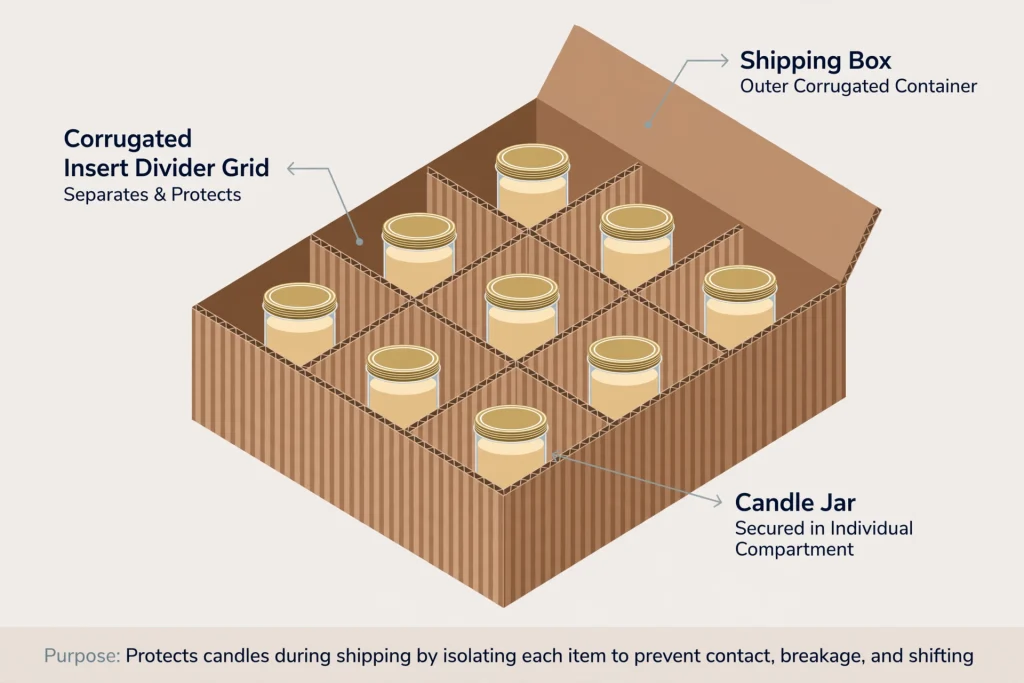
If you ship more than one candle per box, dividers are not optional — they are the primary breakage prevention. A corrugated divider grid keeps each vessel in its own cell so jars cannot strike each other, which eliminates the most common damage mode in multi-packs.
For single candles, a fitted insert keeps the jar centered so cushioning stays evenly distributed on all sides instead of migrating to one side in transit. Options include:
- Corrugated dividers and partitions — the standard for multi-packs; inexpensive, recyclable, and sized to your exact jar diameter.
- Paperboard tray inserts — fold from flat, hold the jar upright, printable for branding.
- Molded pulp inserts — excellent shock absorption and strong sustainability credentials for eco-positioned brands.
- EVA foam fitments — maximum protection for heavy or high-value vessels; best for luxury price points.
Our gift box inserts guide compares EVA foam, paperboard, and lined options in detail. Whichever you choose, the insert must be designed around your actual jar dimensions — a generic insert that almost fits is barely better than no insert. Measure the real vessel and confirm the fit on a physical sample.
Step-by-Step: Packing Candles for Shipping
Follow this sequence for every shipment, whether you pack ten orders a day or ten thousand:
- Inspect before packing. Check each vessel for cracks, chips, and defects before it goes in the box. Packing a damaged candle just moves the complaint one step downstream.
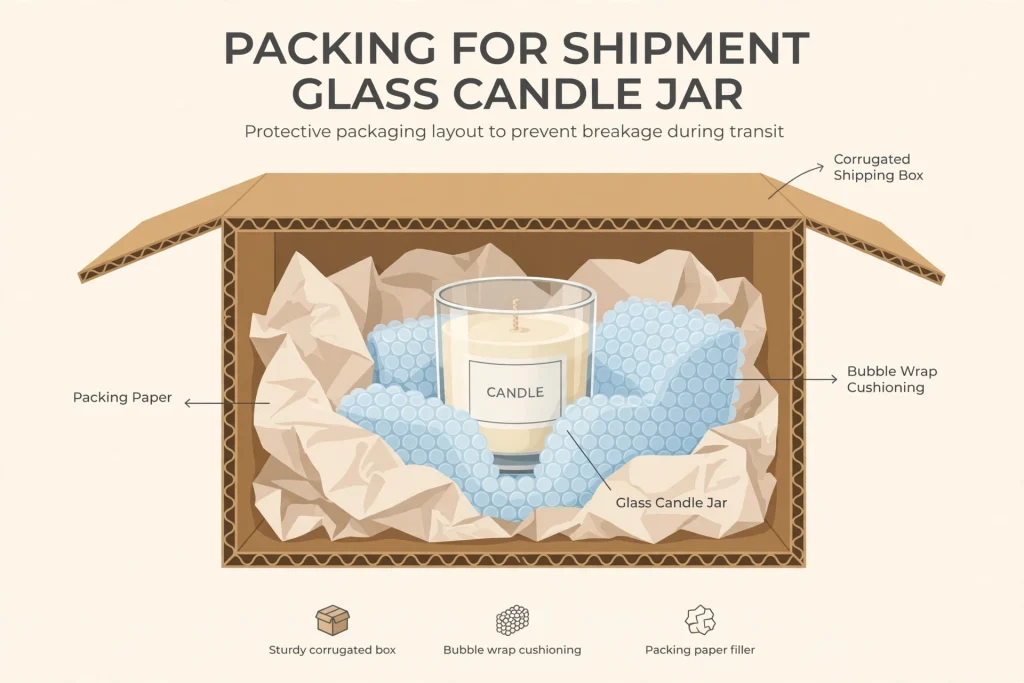
- Protect the surface. Wrap frosted, matte, or metallic vessels in tissue paper first to prevent scuffing, then add the impact layer. For glass jars, bubble wrap or kraft paper honeycomb around the full vessel, secured with tape, is the standard.
- Place in the shipping box with the insert. Set the wrapped candle into its divider cell or fitted insert. The vessel should sit upright with cushioning on all sides — never let a jar rest directly against the box wall.
- Fill every void. Empty space is where damage starts. Fill gaps with crinkle paper, air pillows, or kraft void fill so nothing shifts. Then close the box and give it a firm shake: if you feel or hear movement, add more fill.
- Seal properly. Use pressure-sensitive packing tape (not masking tape) in an H-pattern across the top and bottom seams. For heavy multi-packs, reinforce the box edges — seam failure under weight is a real and common failure mode.
- Label clearly. Mark “FRAGILE” and “THIS SIDE UP” on at least two faces. Labels do not guarantee gentle handling, but orientation marking measurably reduces the number of parcels shipped upside down, which matters for candles with loose lids.
Heat and Melting Protection
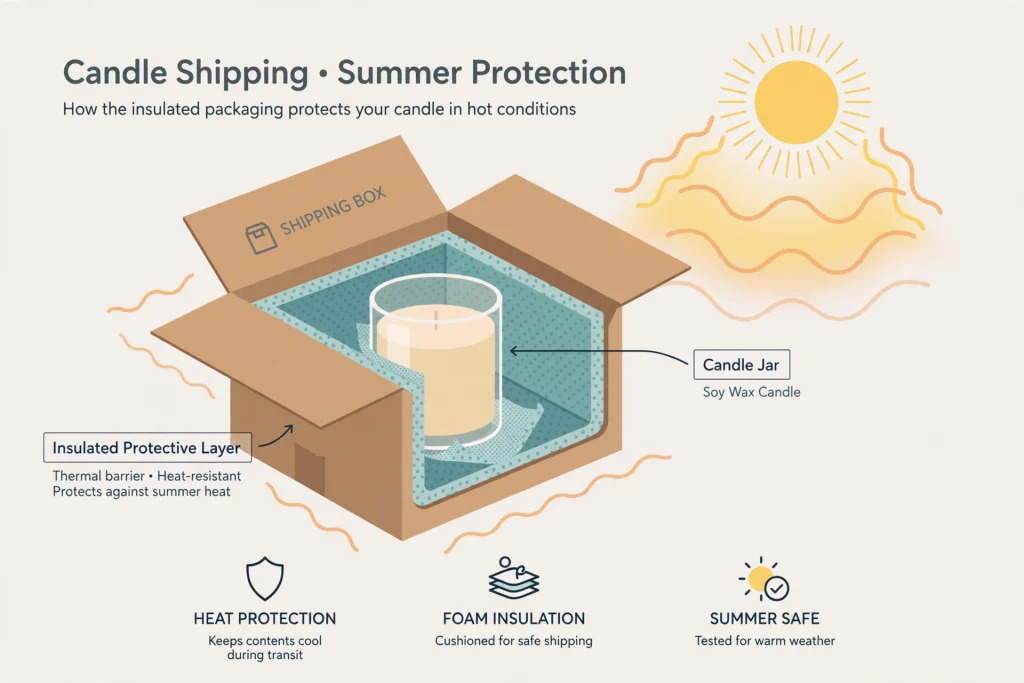
Summer is peak damage season for candle shippers, and heat damage is harder to spot than breakage — the candle looks fine until the customer opens it and finds sweating, frosting, or a shifted wax pool.
Understand your exposure. A parcel can sit in a hot delivery vehicle, on a sunny doorstep, or in a non-climate-controlled warehouse over a weekend. Any shipping plan for candles must assume heat exposure, not hope to avoid it.
Practical heat defenses:
- Ship early in the week. Parcels shipped Thursday or Friday can sit in a warehouse over the weekend. Monday-through-Wednesday dispatch keeps candles moving.
- Choose faster transit in hot months. The fewer days in the network, the less heat exposure. The extra freight cost is usually smaller than the cost of melted-product replacements.
- Use insulated liners for extreme conditions. Foil-lined thermal box liners meaningfully slow heat transfer for shipments heading into heat waves or tropical destinations.
- Add cold packs for high-risk lanes. Gel ice packs help for short transits, but they add weight and eventually warm up — treat them as a supplement to fast shipping, not a replacement.
- Warn the customer. A “your candle ships Monday to avoid weekend heat” note, or delivery instructions to bring the parcel inside promptly, reduces doorstep baking.
One caution: do not over-engineer. Insulated liners plus cold packs on every order year-round will destroy your packaging budget. Match the protection level to the season, the destination climate, and the wax type — and review the plan each spring before temperatures rise.
Test Before You Scale
No packaging specification is proven until a packed box survives realistic handling. Before committing to bulk production:
Run a shake test. Pack a box exactly as production will, seal it, and shake it firmly. Any movement or rattling means the insert or void fill needs redesign.
Run a drop test. Drop packed boxes from typical handling heights (waist height onto concrete is a reasonable proxy) on corners, edges, and flat faces. Inspect the vessels afterward — including hairline cracks, which you find by tapping the glass and listening, not just by looking.
Run a heat test. Leave a packed box in a hot car for an afternoon in summer conditions and inspect the wax surface afterward. This single test prevents more summer complaints than any other step.
Order a structural sample first. We provide free blank structural samples (you cover the courier cost), produced in 3–7 days, so you can verify box strength, insert fit, and cushioning layout with your actual product before bulk production — which runs 15–20 days. Our guide on which packaging sample should you order explains what each sample type proves. Testing a $30 sample beats discovering a flaw in 5,000 shipped units.
Frequently Asked Questions
Can I ship a candle in its rigid gift box without an outer box?
No — not if you want it to arrive presentable. Rigid gift boxes are presentation packaging, not shipping packaging: they scuff, dent, and crush in parcel networks. Always place the retail box inside a corrugated shipping box with cushioning between the two.
What is the best box for shipping a single candle jar?
A snug E-flute or B-flute corrugated mailer with about 5 cm of cushioning space on all sides, a fitted insert or wrap keeping the jar centered, and all voids filled. E-flute keeps the parcel slim and printable; B-flute adds protection for heavier jars.
How do I stop candles from melting during summer shipping?
Ship early in the week to avoid weekend warehouse holds, use faster transit times in hot months, add insulated liners for high-risk routes or heat waves, and consider gel packs for short, extreme exposures. Also tell customers to bring parcels inside promptly — doorstep heat is a major damage source.
Do I really need dividers for multi-packs?
Yes. Jar-on-jar contact is the leading cause of breakage in multi-candle shipments. A corrugated divider grid sized to your jar diameter is inexpensive, recyclable, and eliminates the problem entirely. Wrapping each jar individually without dividers still allows wrapped vessels to knock together.
Should I test my candle packaging before ordering in bulk?
Absolutely. Run shake, drop, and heat tests on production-packed samples with your actual vessels. Order a blank structural sample first to verify fit and strength — it takes 3–7 days and costs far less than discovering a packaging flaw across a full production run.
Ship Candles That Arrive Like They Left
Candle shipping succeeds when you design for both enemies at once: corrugated protection and dividers against breakage, plus transit planning and insulation against heat — all verified by testing with your real product before you scale.
If you are developing candle packaging and want a manufacturer to review your box specification, insert design, or sample plan, contact us. We have spent 15+ years producing paper packaging for brands in 50+ countries, and we will tell you honestly what your candles need to survive the journey.