Most buyers use the word “foil” as if it meant one thing. On the production floor, it means two completely different processes — hot foil stamping and cold foil printing — and they differ in finish quality, cost structure, and the quantities they suit. Specifying the wrong one is how brands end up with a dull metallic that was supposed to shine, or pay for tooling they never needed.
This guide compares the two methods from a manufacturer’s point of view, so you can specify the right one for your custom cosmetic packaging before you approve artwork and pay for setup.
The Short Answer
Choose hot foil stamping for the deepest mirror-like metallic on logos and seals, for textured or uncoated stocks, or when you want foil and embossing in a single impression.
Choose cold foil printing for large foil coverage, fine detail combined with full-color printing, or metallic brand colors created by overprinting ink on silver foil — at quantities where inline press efficiency pays off.
Both are real foil, not metallic ink. The difference is how the foil gets onto the sheet.
How Hot Foil Stamping Works
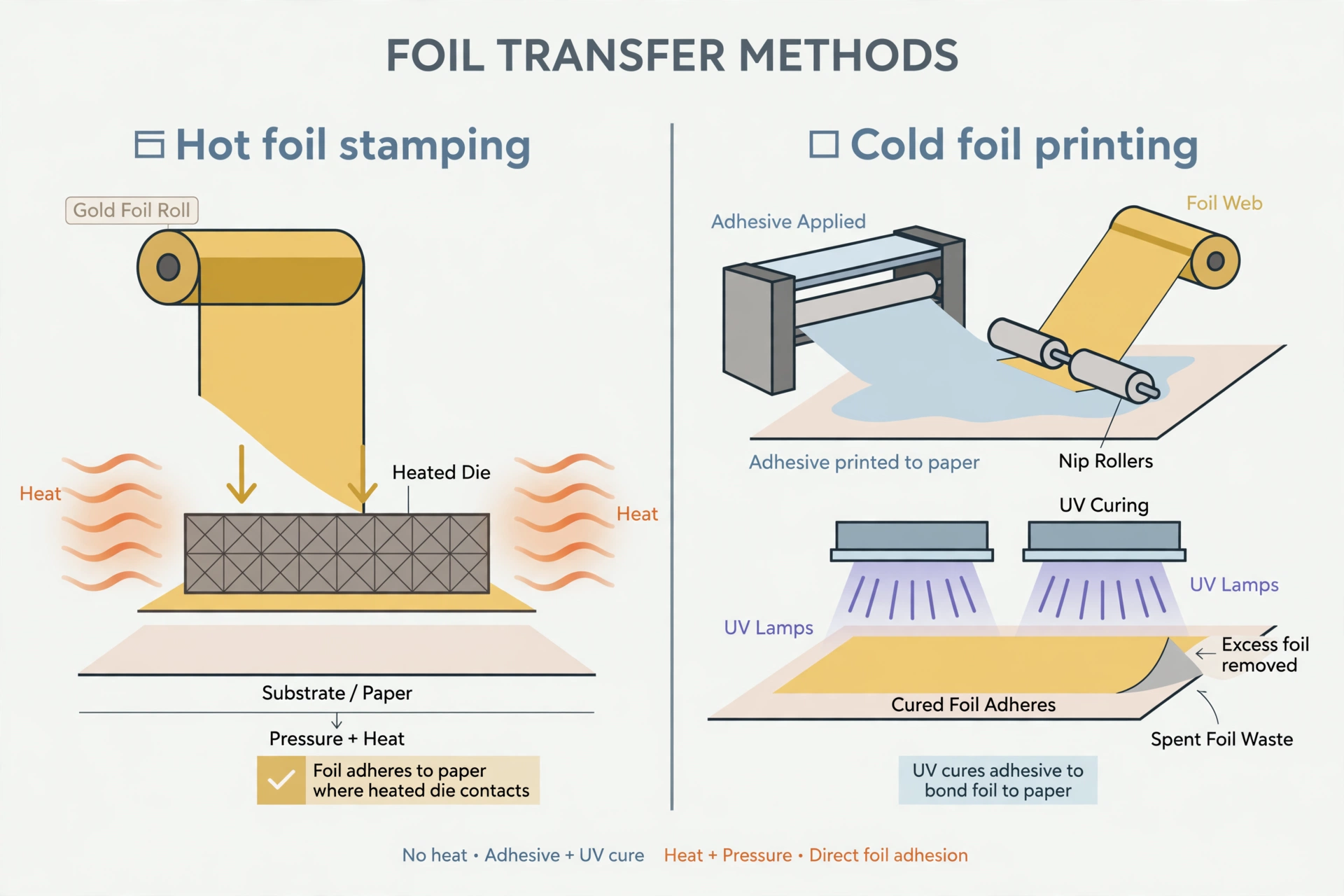
Hot foil stamping is the traditional method, and probably what you picture when you hear “foil.” A heated custom metal die presses a roll of foil film against the sheet. Where the die makes contact, heat and pressure activate the foil’s adhesive layer and transfer the metallic or pigment layer onto the substrate. (For the full background on foil types and general design rules, see our guide on how foil stamping works.)
It is normally an offline process: printed sheets go through a separate foiling press after printing. Because heat and pressure physically force the foil onto the surface, hot stamping works on a wide range of substrates — including textured and uncoated stocks that other finishes struggle with. It also allows foil and embossing to be done in one hit, with the same die pressing the design into the board while the foil transfers.
The trade-offs come from the die itself. Every design needs its own custom die (a fixed tooling cost), very thin lines can fill in, and large solid foil areas can show mottling because pressing a big flat die evenly is difficult.
How Cold Foil Printing Works
Cold foil printing applies foil inline on an offset printing press, with no heated die and no separate stamping pass:
- A standard printing plate lays down UV-curable adhesive where the foil should appear — like printing a fifth color.
- A foil web is nipped against the tacky adhesive as the sheet passes through.
- UV lamps cure the adhesive instantly, bonding the metallic layer to the sheet.
- The carrier film peels away, leaving foil only where adhesive was printed.
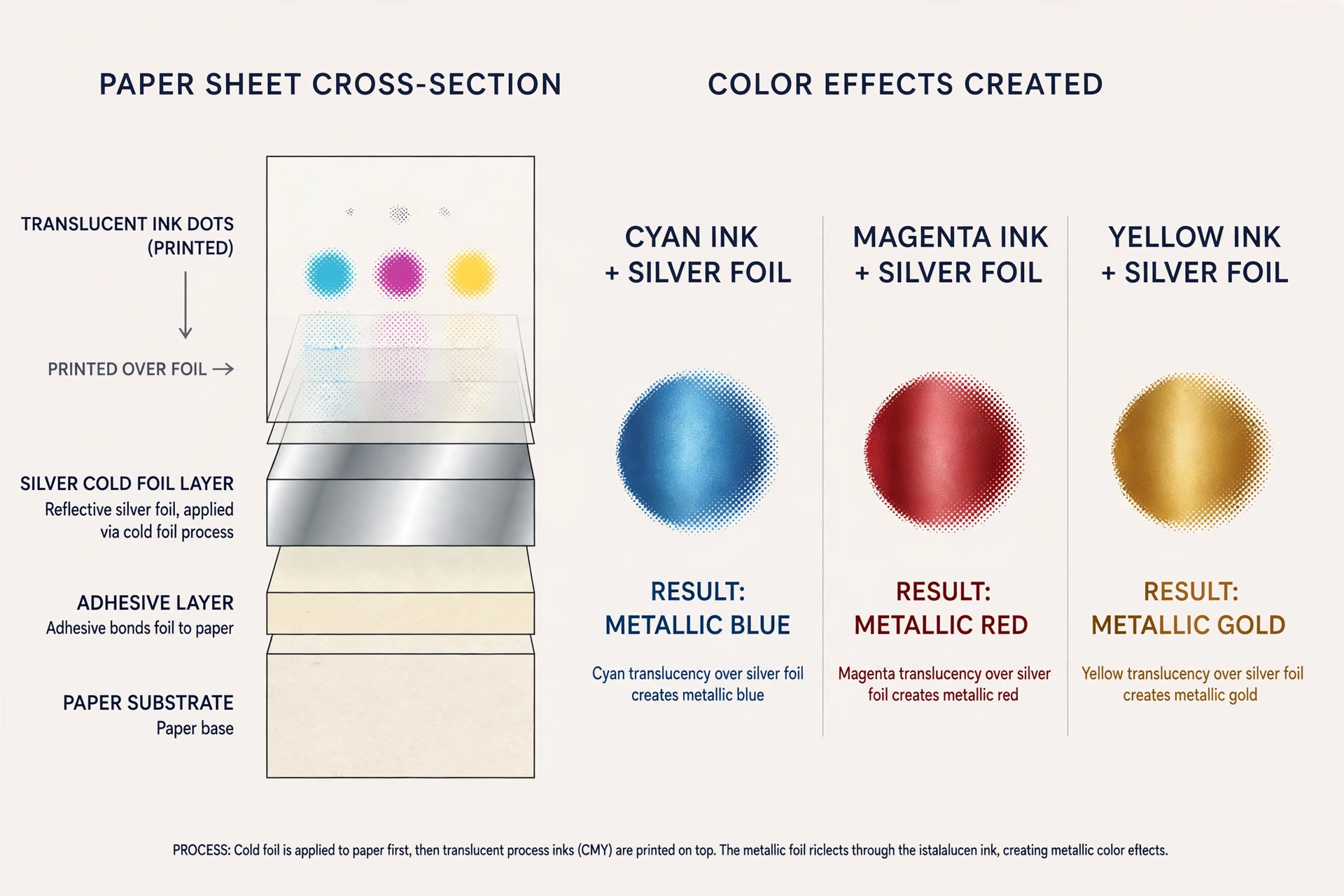
Because the foil image is printed with a plate rather than pressed with a die, cold foil handles fine detail and large solid areas with ease — two things hot stamping finds difficult. And because it happens inline, the press can immediately overprint CMYK inks on top of the foil in the same pass. Print process blue over silver foil and you get a metallic blue; print photography over foil and you get shimmering metallic imagery. This overprint capability is cold foil’s signature creative advantage.
The constraints are on the equipment and substrate side. Cold foil needs a press fitted with a cold-foil unit and UV curing — not every packaging manufacturer has one, so confirm capability before you specify it. Adhesion demands a smooth, coated surface; uncoated or heavily textured stocks give unreliable results. And because it runs on an offset press with real setup time, cold foil favors medium-to-long runs where inline speed offsets the makeready.
Hot Foil vs Cold Foil: Side-by-Side Comparison
| Factor | Hot foil stamping | Cold foil printing |
|---|---|---|
| Process | Heated metal die presses foil onto sheet (offline) | UV adhesive printed by plate, foil nipped on inline |
| Metallic brilliance | Deepest, most mirror-like finish | Bright, but slightly less mirror depth |
| Fine detail | Good; very thin lines can fill in | Excellent — printed at plate resolution |
| Large solid areas | Difficult — can mottle under a large die | Excellent — no die pressure issues |
| Metallic colors (overprint) | Not typical — foil color is the foil color | Yes — CMYK overprint on silver foil in one pass |
| Foil + embossing in one hit | Yes, standard combination | No — separate embossing pass needed |
| Substrates | Wide range, incl. textured and uncoated stocks | Best on smooth, coated stocks |
| Tooling | Custom metal die per design | Printing plate + adhesive (no die) |
| Speed | Slower, offline pass | Fast, inline with printing |
| Best run sizes | Flexible — from modest runs upward | Medium to long runs where inline efficiency pays off |
Finish Quality: Where the Difference Shows Most
If your design centers on a single foil logo or seal that must look as reflective as possible — the classic gold logo on a rigid gift box lid — hot foil remains the benchmark. The heat-and-pressure transfer lays the metallic layer down densely, which is why hot-stamped gold has that unmistakable mirror depth.
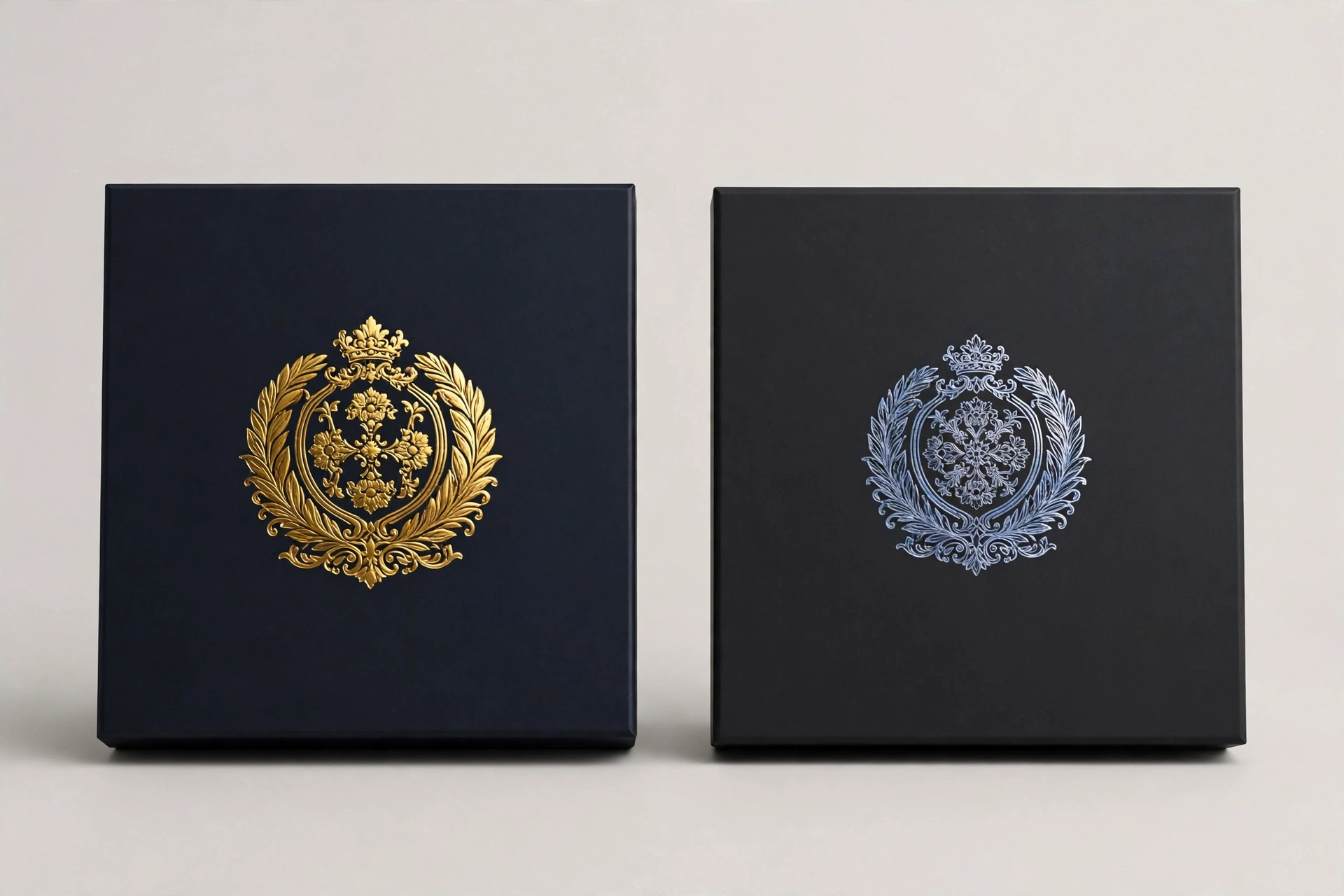
Cold foil earns its place with more ambitious designs: all-over foil patterns, large foil background panels, or foil woven through fine typography. And because CMYK or Pantone inks can be printed directly over the foil inline, cold foil opens up metallic brand colors that hot foil cannot produce without a custom-colored foil roll.
Cost: What Actually Drives the Price
Neither method is universally cheaper. What you pay for is different in each case:
Hot foil costs are driven by:
- The die. A custom metal die per design is a fixed one-time cost — this is why per-unit cost falls as quantity rises.
- The offline pass. Sheets go through a separate foiling press, which means extra makeready and slower running speeds than inline printing.
- Foil area and foil type. More coverage uses more foil film; holographic and specialty foils cost more than standard gold or silver.
Cold foil costs are driven by:
- Press setup. Mounting the foil unit, registering the adhesive plate, and dialing in UV curing take real makeready time on an offset press — economical only when the run is long enough to absorb it.
- Plates and adhesive. Lower fixed cost than a metal die, but still a per-design setup.
- Coverage efficiency. Once running, large foil areas cost little extra — the press is already moving at full speed.
The practical takeaway: for a modest run with one foil accent, hot stamping’s die cost is usually the simpler path. For long runs with extensive foil coverage — especially combined with full-color printing — cold foil’s inline speed can bring per-unit cost down significantly. Always compare quotes on the same quantity and foil area.
Substrates: Which Stocks Suit Each Method
Hot foil’s heat and pressure make it the forgiving option. It works beautifully on coated art paper and rigid greyboard, and it remains the go-to choice for textured stocks, soft-touch laminations, and uncoated kraft where an adhesive-based method would struggle. (For a broader overview of board and liner options, see our paper material guide.)
Cold foil is pickier: it wants a smooth, coated surface for the UV adhesive to grip reliably — coated art paper, coated paperboard, and laminated rigid wraps are ideal. If your brand story depends on an uncoated or textured stock, that alone usually settles the decision in favor of hot foil.
When to Choose Hot Foil Stamping
- Your design needs maximum metallic brilliance on a logo, monogram, or seal — the classic luxury look on custom perfume boxes and rigid gift boxes
- The stock is textured, uncoated, or soft-touch laminated
- You want foil and embossing combined in a single impression
- The run is modest and the foil area is a focused accent rather than all-over coverage
- You need the most predictable result across reorders — a stored brass die reprints identically
When to Choose Cold Foil Printing
- Large foil areas, all-over patterns, or foil backgrounds
- Metallic brand colors via CMYK overprint on silver foil
- Fine detail combining foil and full-color printing in tight registration
- Medium-to-large quantities, where inline press speed offsets setup
- Smooth, coated stocks (art paper, coated board, laminated wraps)
- First confirm your supplier runs a cold-foil unit. Cold foil is a press configuration, not a material — ask for samples of their cold foil work on your intended stock before committing the design.
Design File Notes for Either Method
- Supply foil areas as vector artwork on a separate layer, exactly as you would a spot color. Name it clearly (e.g., “FOIL”) so prepress routes it to the die-maker or the adhesive plate correctly.
- Respect minimum line weights — hairline rules and tiny reversed text are the most common failure point in hot foil. Your manufacturer will advise the exact limits.
- For cold foil overprint designs, build two layers: the foil adhesive area and the CMYK artwork printed over it. Check trapping where foil meets non-foil areas.
- If you are comparing hot foil against other finishes entirely, our foil stamping vs spot UV comparison covers when each finish earns its place.
Buyer Checklist: Decide in 6 Questions
- Must the metallic be as mirror-bright as possible on a logo or seal? → Hot foil.
- Does the design need large foil coverage or an all-over pattern? → Cold foil.
- Do you want metallic brand colors via ink overprint? → Cold foil.
- Is the stock textured or uncoated? → Hot foil.
- Should foil and embossing happen in one impression? → Hot foil.
- Is the run long with foil plus full-color printing? → Cold foil (after confirming supplier capability).
If you answer “not sure” to most of these, the reliable move is to request physical samples of both methods on your actual stock — holding them side by side settles the question faster than any specification sheet.
How to Request an Accurate Quote
Foil pricing only makes sense with the full picture. To get a comparable quote, prepare:
- Box type and dimensions (L × W × H) and product weight
- Foil area and color — which elements get foil, approximate coverage, foil color (gold, silver, rose gold, holographic, pigment)
- Hot or cold — or “please recommend based on the artwork”
- Quantity per design
- Print colors (CMYK, Pantone, or both) and whether printing runs inline with the foil
- Other finishes — embossing, lamination, spot UV — each adds a pass
- Shipping destination and preferred terms
Send your dieline or artwork with these specs, and ask for a physical proof on the chosen stock before mass production. At Yingye Packaging, bulk production runs 15–20 days after sample approval and sampling takes 3–7 days — build the proof step into your launch timeline.
FAQ
Is cold foil as shiny as hot foil?
Close, but not identical. Cold foil is bright and reflective; hot foil has a deeper mirror quality because heat and pressure bond the metallic layer more densely. For a single prestige logo, most manufacturers still recommend hot foil. For large coverage and metallic color effects, cold foil’s other advantages outweigh the small difference.
Can cold foil do holographic effects?
Holographic cold foil films exist, and overprinting means you can create custom holographic color effects inline. That said, the sharpest holographic patterns on rigid boxes are still most commonly done with hot foil, where die pressure gives the cleanest pattern transfer. Ask your supplier to show samples of both on your stock.
Which is cheaper — hot or cold foil?
It depends on the job, not the method. Hot foil carries a fixed die cost plus a slower offline pass; cold foil carries press setup cost but runs fast inline. Modest runs with a focused foil accent usually favor hot foil, while long runs with extensive coverage favor cold foil. Compare quotes at the same quantity and the same foil area.
Can I combine foil with embossing?
Yes — and this is one of hot foil’s distinct advantages: foil and embossing can be done in a single impression with a combination die. With cold foil, embossing needs a separate pass after printing.
How do I know if my supplier can do cold foil?
Ask directly, and ask for proof: physical samples of cold foil work on the stock you plan to use, plus confirmation that their press has UV curing for the adhesive. If a supplier only offers hot foil stamping, that is completely normal — many packaging manufacturers specialize in it — but then your design should be planned around hot foil from the start. (At Yingye Packaging, blank structural samples are free; you cover the courier fee.)
Ready to specify your foil finish? Send us your box type and dimensions, the foil area and color you have in mind, your quantity, print colors, and shipping destination — and tell us whether you lean toward hot or cold foil, or would like a recommendation based on your artwork. Get a quote or browse our custom cosmetic packaging solutions to see the structures this finish is most often specified on.