
Measuring a box sounds like the simplest step in a packaging project — until it goes wrong. A box that is half an inch too small means the product does not fit, and the whole production run has to be redone. A box measured on the outside when the inside mattered means a shipping quote built on the wrong numbers. As a packaging manufacturer, we see measurement mistakes behind a surprising share of reprints, delayed launches, and unexpected freight bills.
The good news is that box measurement follows a small set of conventions. Once you know the L × W × H order, the difference between inside and outside dimensions, and the handful of mistakes to avoid, you can communicate sizes clearly with any supplier — and check that what arrives matches what you ordered.
Why Accurate Box Measurement Matters
Box dimensions drive three things that directly affect your cost and your customer experience: product fit, shipping cost, and manufacturability.
Product fit. A box that is too tight crushes the product or makes packing slow and frustrating on your fulfillment line. A box that is too loose lets the product shift in transit, which means more damage claims — and more filler material, which adds cost and hurts the unboxing experience. Getting the internal dimensions right is the foundation of protective packaging.
Shipping cost. Carriers calculate freight using the outside dimensions of the package. If you are comparing quotes or estimating dimensional (DIM) weight, the numbers you give the carrier must be the external measurements of the sealed, ready-to-ship box. Measure wrong, and the quote you budgeted against will not match the invoice. Our guide to choosing the right packaging box size explains how size decisions connect to freight cost.
Manufacturability. Every custom box starts as a dieline — the flat cutting template — and the dieline is built directly from your dimensions. An error at the measuring stage propagates into tooling, samples, and finally into thousands of finished boxes. Catching a measurement mistake on paper costs nothing; catching it after production costs the entire order.
The L × W × H Convention: How to Read Box Dimensions
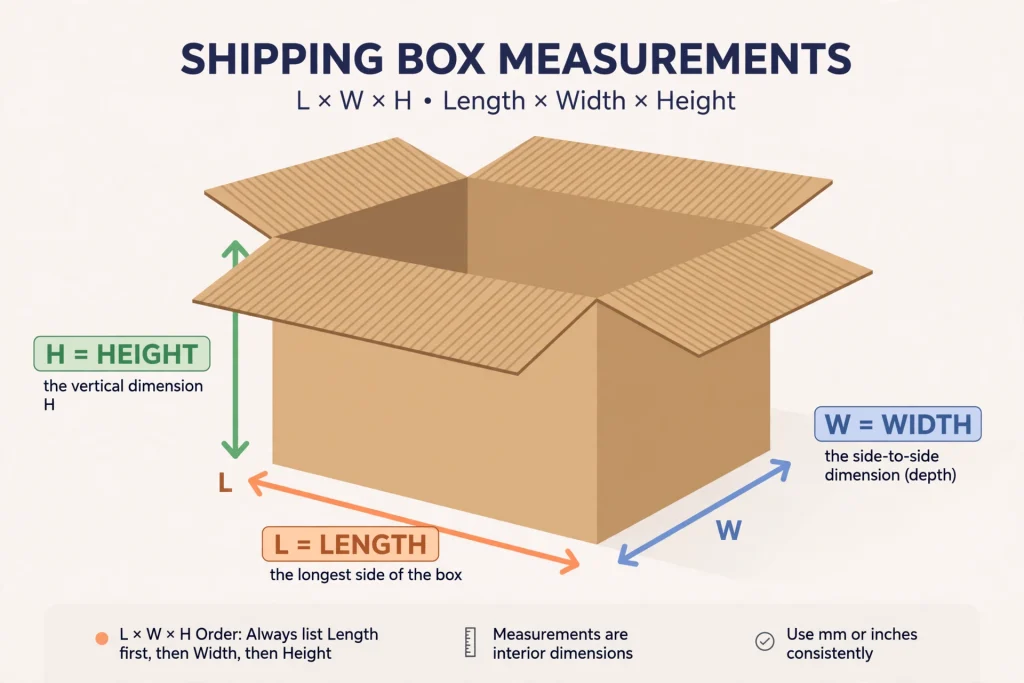
In the packaging industry, box dimensions are always listed in the same order: Length × Width × Height (L × W × H).
- Length is the longest side of the box opening.
- Width is the shorter side of the box opening, measured at 90 degrees to the length.
- Height (sometimes called depth) is the vertical measurement, from the bottom of the box to the top, with the box standing in its normal orientation.
So a box listed as 12 × 9 × 4 in is 12 inches long, 9 inches wide, and 4 inches tall. This order is the industry standard across packaging manufacturing, corrugated supply, and freight — which is why using it consistently prevents miscommunication between you, your designer, your supplier, and your carrier.
A few practical notes on reading dimensions:
- Units must be consistent. Never mix inches and centimeters in one set of dimensions. If your supplier works in millimeters and your carrier quotes in inches, convert the full set — do not convert only one side.
- Know which dimension is the opening. On a mailer box, length and width describe the opening; on a tall rigid gift box, confirm with your supplier which panel they call the front before you place artwork.
- “Height” vs “depth” means the same thing in most packaging contexts. If a specification says “depth,” treat it as the vertical measurement unless the drawing indicates otherwise.
| Listed As | Length | Width | Height |
|---|---|---|---|
| 12 × 9 × 4 in | 12 in (longest side) | 9 in (shorter side) | 4 in (vertical) |
| 300 × 200 × 100 mm | 300 mm | 200 mm | 100 mm |
| 8 × 8 × 8 in | 8 in | 8 in | 8 in (cube — measure every side anyway) |
Even for a cube-shaped box, measure all three sides individually. Boxes that look square often are not, and assuming symmetry is one of the most common sources of error.
Inside vs Outside Dimensions: Which One Do You Need?
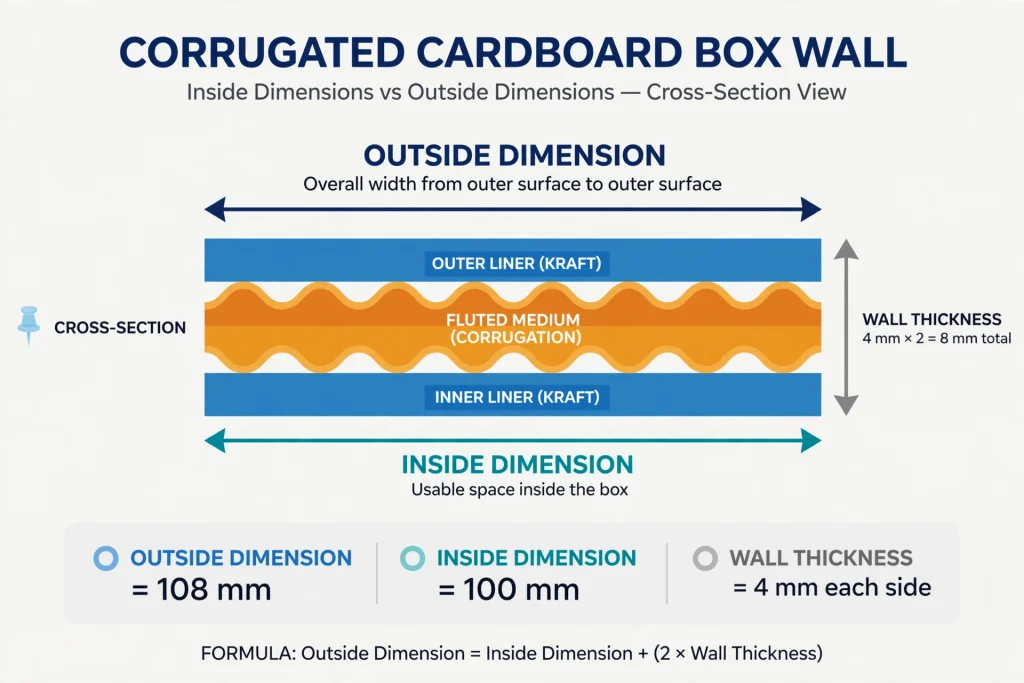
This is the distinction that causes the most confusion — and the most expensive mistakes. Every box has two sets of dimensions:
- Inside dimensions (ID): the usable space within the box. This is what determines whether your product fits.
- Outside dimensions (OD): the full external size of the closed box, including the thickness of the board. This is what carriers measure and what determines your shipping cost.
The difference between ID and OD is the board thickness, counted twice on each axis (once for each wall). For a corrugated mailer box, the flute adds meaningful thickness:
| Board Type | Typical Wall Thickness | Added to Each Dimension (OD − ID) |
|---|---|---|
| E-flute corrugated | ~1.5 mm | ~3 mm |
| B-flute corrugated | ~3 mm | ~6 mm |
| Double-wall corrugated | ~7 mm | ~14 mm |
| Rigid greyboard (1.5–2 mm) | ~1.5–2 mm + wrap | ~4–5 mm |
(These are typical industry ranges — always confirm the exact caliper of the board your supplier will use.)
The rule is simple: use inside dimensions when checking product fit, and outside dimensions when calculating shipping. When you request a quote from a manufacturer, state which one your numbers represent. A professional supplier will ask, but stating it upfront removes a round of clarification. Our comparison of E-flute vs B-flute shipping boxes shows how flute choice changes both wall thickness and the ID/OD gap.
One more nuance: if your box includes an insert — a paperboard tray, corrugated divider, or foam fitment — the insert also consumes internal space. Measure the product against the inside dimensions with the insert in place, not the empty box.
Step-by-Step: How to Measure a Box Correctly
You need a tape measure (one showing both inches and centimeters is ideal), a flat surface, and a notepad. Follow these steps:
- Assemble the box completely. Measure the box in its finished, assembled state — never flat or partially folded. A flat mailer blank has completely different measurements from the assembled box, and quoting from flat measurements is a classic error.
- Close the flaps and tape as it will ship. For outside dimensions, close the box exactly as it will travel: flaps folded, tape applied. For inside dimensions, open the top flaps and measure the interior cavity.
- Measure the length. Find the longest side of the box opening and measure edge to edge along the outside. Keep the tape straight and level — do not follow any curve or bulge.
- Measure the width. Rotate 90 degrees and measure the shorter side of the opening, edge to edge, perpendicular to the length.
- Measure the height. With the box standing upright and flaps closed, measure vertically from the bottom to the top. Do not include the thickness of tape or labels, but do account for any bulge — if the box bulges, measure at the widest point, because that is what the carrier will measure.
- Record in L × W × H order with units. Write it as “12 × 9 × 4 in (OD)” or “300 × 200 × 100 mm (ID)” — the parenthetical noting inside or outside removes all ambiguity.
- Round up for shipping, keep exact for manufacturing. When giving dimensions to a carrier for a quote, round each measurement up to the next whole unit — carriers do this anyway, and rounding down risks surcharges. When giving dimensions to your box manufacturer, provide exact measurements; tooling is cut to the millimeter, and rounding introduces fit errors.
Common Measuring Mistakes (and How to Avoid Them)
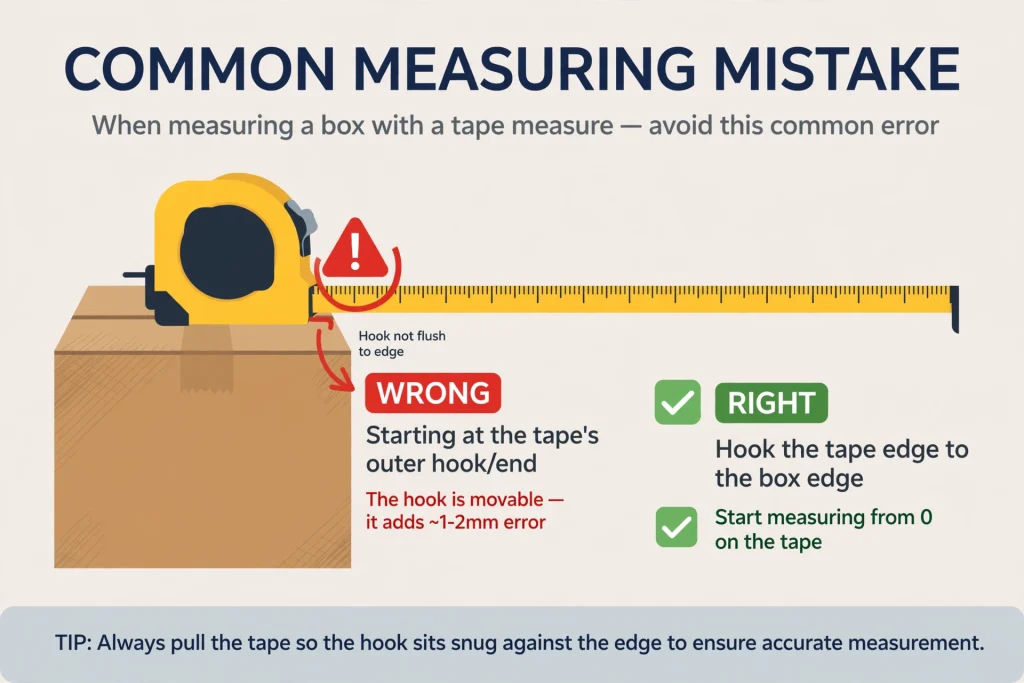
- Measuring the box flat. A folded mailer blank’s “length” is not the assembled box’s length. Always measure assembled.
- Mixing up inside and outside. Giving your supplier the OD when they need the ID (or vice versa) produces a box that does not fit or a freight quote that does not match. Label every number.
- Wrong dimension order. Writing W × H × L when the supplier reads L × W × H puts your artwork on the wrong panel and your product in the wrong orientation. Stick to L × W × H.
- Forgetting the insert. The box fits the product on paper, but the insert eats 10 mm on each side and now the lid will not close. Measure with inserts installed.
- Ignoring bulge and overfill. If your product makes the box bulge, the carrier measures the bulge. Either size up or compress the contents — do not hope the carrier will not notice.
- Rounding down. Rounding 12.4 inches down to 12 for a freight quote invites a dimensional-weight adjustment on the invoice. Round up.
- Assuming square means square. Measure every side of every box, every time — including reorders, since tooling and board lots can shift slightly between runs.
- Measuring only one sample. Board thickness varies slightly across a production run. For critical fits, measure several boxes and work from the smallest inside dimension, not the average.
Measurement Notes by Box Type
Different box constructions have their own measuring quirks worth knowing.
Corrugated mailer boxes. The workhorse of e-commerce shipping. Measure OD for freight quotes and ID for product fit, and remember that flute choice changes the wall thickness — a B-flute mailer has roughly twice the ID/OD gap of an E-flute mailer in the same nominal size. If you are still selecting a size, our custom mailer box size guide walks through standard size ranges, and our article on how to calculate the right box size for your products covers the math. For shippers, our custom mailer boxes are built to the exact OD your carrier will charge against.
Folding cartons. These retail boxes are specified by their panels, so ID accuracy matters most — the carton must grip the product without crushing it. Because folding cartons ship flat and assemble at the packing station, also confirm the assembled dimensions on a physical sample, not just the flat dieline.
Rigid gift boxes. Rigid boxes do not collapse, so the finished box you measure is the finished box you ship — but remember they almost always travel inside an outer shipping carton, which adds another layer of OD for freight. Also allow clearance for the insert: a rigid box with a fitted tray can lose significant internal height to the insert base.
Frequently Asked Questions
Should I measure the inside or the outside of the box?
It depends on what the number is for. Use inside dimensions (ID) when checking whether your product and insert fit. Use outside dimensions (OD) when getting freight quotes, calculating dimensional weight, or checking carrier size limits. When in doubt, provide both and label them clearly.
What order do box dimensions go in?
Length × Width × Height (L × W × H). Length is the longest side of the opening, width is the shorter side, and height is the vertical measurement. This is the standard order across packaging manufacturing and shipping — using it consistently avoids miscommunication.
How much bigger should the box be than my product?
There is no single rule because it depends on the product’s fragility, the insert, and the cushioning. As a starting point, many shippers allow roughly 5–10 mm of clearance per side for the product plus insert, then add cushioning as needed. The reliable method is to measure your actual product, build in the insert thickness, and confirm the fit on a physical sample before bulk production.
Do I include the flaps when measuring box height?
For outside dimensions, measure the closed box as it will ship — flaps folded and taped, measured at the tallest point. For inside dimensions, measure the interior cavity with flaps open. Do not add flap length to the height; flaps fold over the opening rather than extending the box upward.
Why doesn’t my delivered box match the dimensions I ordered?
Small manufacturing variances are normal in paper packaging — board caliper, humidity, and scoring all introduce tiny shifts. If the difference is minor and the product still fits, it is within normal tolerance. If the fit is affected, measure several boxes, document the ID and OD with photos, and raise it with your supplier; a physical pre-production sample approved before bulk production is the best protection against surprises.
Get Dimensions Right Before You Order
Accurate measurement is a small effort that prevents the most expensive packaging mistakes: misfit products, reprinted runs, and freight invoices that do not match the quote. Measure assembled, label inside vs outside, keep L × W × H order, and always confirm critical fits on a physical sample.
If you are developing custom packaging and want a manufacturer to review your dimensions before tooling, contact us — and browse our custom mailer boxes to see the structures we build to exact specification.