
If you have ever received a packaging quotation listing “300gsm art paper” or “350gsm duplex board” and wondered what those numbers actually promise, you are not alone. GSM is one of the most quoted — and most misunderstood — specifications in the paper packaging industry. Buyers routinely treat it as a direct measure of strength or quality, and that assumption leads to boxes that are either over-specified and overpriced, or under-specified and disappointing.
GSM stands for grams per square meter. It tells you exactly one thing: how much one square meter of a given paper weighs. A 300 GSM sheet means a one-square-meter piece of that paper weighs 300 grams. That is the whole definition — and understanding both what it covers and what it leaves out is the key to specifying paper correctly for your packaging.
This guide explains GSM in plain terms, shows how it differs from thickness and density, converts it against the US basis-weight system, and gives you a practical chart matching typical GSM ranges to common box types. By the end, you will be able to read any paper specification with confidence and discuss it with your supplier on equal footing.
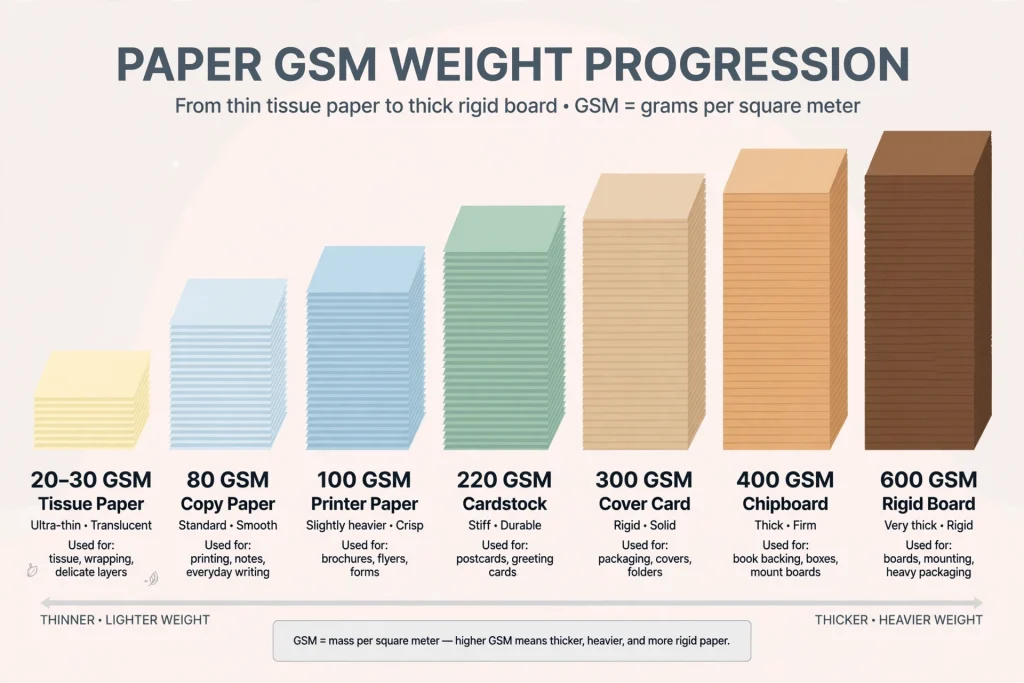
What Does GSM Actually Mean?
GSM is a measure of areal density: the mass of paper per unit of area. The formula is simple — GSM equals the weight of a paper sample in grams divided by its area in square meters. Because it is expressed per square meter regardless of the actual sheet size, GSM lets buyers compare papers from different mills, countries, and sheet sizes on a single universal scale.
This universality is why the packaging industry outside the United States relies on GSM almost exclusively. When a Chinese manufacturer quotes 250 GSM white card and a European mill quotes 250 GSM folding boxboard, both are describing the same weight per area. The fibers, coatings, and stiffness may differ, but the GSM figure itself is directly comparable.
What GSM does not tell you is just as important. It does not measure thickness. It does not measure stiffness, burst strength, or tear resistance. Two papers can share the same GSM and behave very differently in a finished box — a point we will return to, because it is the source of most buyer mistakes.
GSM vs Thickness vs Density: Three Different Properties
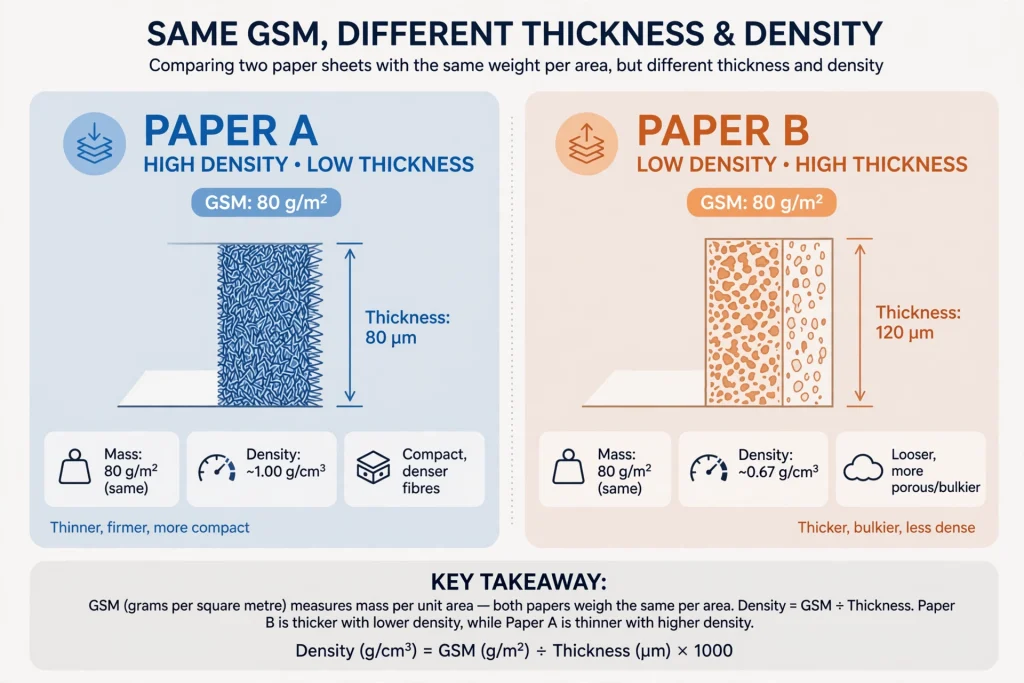
The most common confusion in paper specification is treating GSM, thickness, and density as interchangeable. They are related, but they measure different things, and a box performs according to all three.
GSM measures weight per area, as described above. Thickness — called caliper in the industry — measures the physical distance from one surface of the sheet to the other, usually expressed in millimeters or microns. Density describes how tightly the paper fibers are packed together, which determines how much thickness you get for a given weight.
The relationship is straightforward: for the same GSM, a denser paper is thinner and a less dense paper is thicker. Coated art paper is heavily calendared (pressed between rollers), so its fibers sit tightly together. A 350 GSM coated art paper might measure around 0.32 mm thick. An uncoated kraft board at the same 350 GSM, with its looser, bulkier fiber structure, can measure noticeably thicker — yet both weigh exactly the same per square meter.
Why does this matter for your box? Because stiffness — the property that keeps a folding carton from collapsing and gives a rigid box its solid feel — depends on both thickness and fiber composition, not on GSM alone. A thicker sheet at the same GSM generally produces a stiffer box, which is why experienced buyers ask for caliper alongside GSM when structural performance matters. When your supplier quotes paper, ask for both numbers: GSM for weight, and thickness in millimeters for structure.
GSM vs US Basis Weight: Translating Between Systems
If you work with US-based designers or printers, you will encounter a second system: basis weight, expressed in pounds. Basis weight is the weight in pounds of 500 sheets (one ream) of paper at its “basic size” — and here is the catch: the basic sheet size differs by paper grade. The basic size for bond paper is 17″ × 22″, for cover stock it is 20″ × 26″, and for text paper it is 25″ × 38″.
This means an “80 lb” figure is meaningless without knowing which grade it refers to. 80 lb cover stock and 80 lb text paper are completely different weights — roughly 216 GSM versus 118 GSM. This is the single biggest source of transatlantic specification errors, and it is worth double-checking every time a US partner quotes in pounds.
The table below gives approximate conversions for the weights most commonly used in packaging. Treat these as working approximations rather than exact equivalents, since the conversion depends on the specific grade.
| GSM | Approx. US Equivalent | Feels Like |
|---|---|---|
| 80 GSM | 20 lb bond | Standard office copy paper |
| 120 GSM | 32 lb bond | Quality letterhead |
| 170 GSM | 65 lb cover | Flyer or brochure stock |
| 200 GSM | 80 lb cover | Sturdy brochure cover |
| 250 GSM | 92 lb cover | Light carton stock |
| 300 GSM | 110 lb cover | Business card stock |
| 350 GSM | 130 lb cover | Premium packaging board |
When in doubt, ask your supplier to confirm the GSM. It is the unambiguous number, and any professional packaging manufacturer works in GSM as the primary specification.
Paper GSM Chart for Packaging Boxes
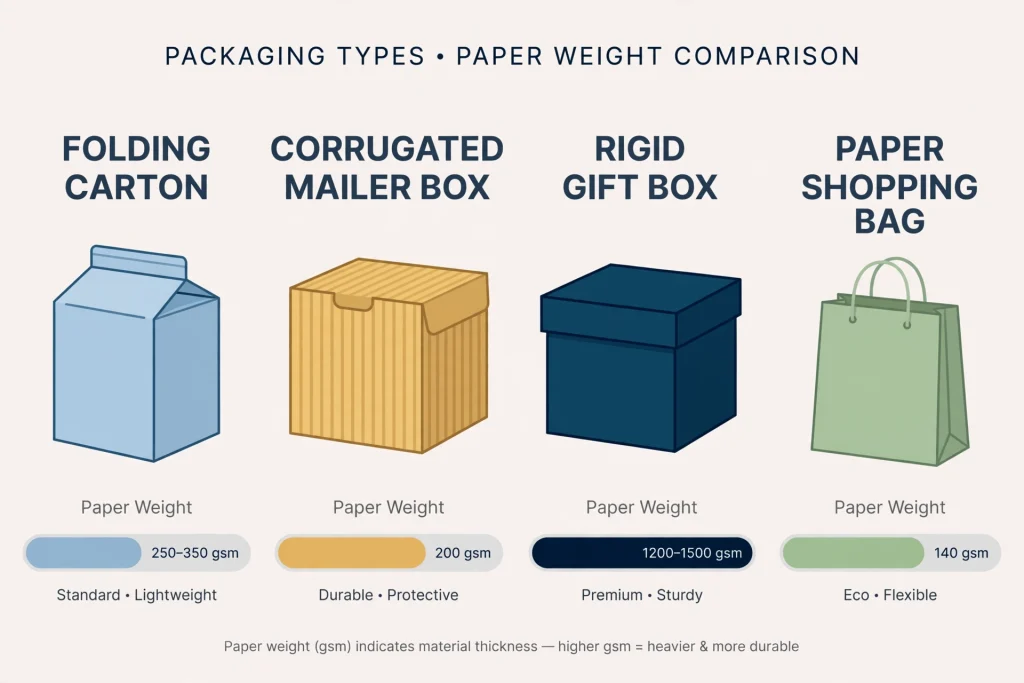
The chart below matches typical GSM ranges to common packaging applications. These are industry-typical ranges, not rigid rules — the right choice always depends on your product weight, box structure, printing method, and budget. Use this as your starting reference when discussing specifications with a supplier.
| Packaging Type | Typical GSM Range | Notes |
|---|---|---|
| Tissue / wrapping paper | 17–40 GSM | Lightweight protective wrap; 17 GSM is standard tissue |
| Labels and stickers | 70–150 GSM | Depends on adhesive backing and application |
| Paper shopping bags | 120–200 GSM | Kraft paper most common in this range |
| Folding cartons (SBS, duplex board) | 230–400 GSM | Retail boxes; 300–350 GSM is the most common band |
| Hang tags | 250–400 GSM | Needs rigidity to hang without curling |
| Rigid box wrapping paper | 120–157 GSM | Art paper wrapped over greyboard; the board core provides the structure |
| Corrugated board (combined) | 400–1,200 GSM | Total combined weight of liners plus fluting medium |
A few notes on reading this chart. For folding cartons, the 300–350 GSM band covers the majority of retail packaging — sturdy enough for shelf presence, printable enough for quality graphics. For corrugated mailer boxes, the combined GSM includes all layers (two liners plus the fluted medium), so it runs much higher; here the flute profile matters more for strength than the liner GSM alone, as our E-flute vs B-flute guide explains in detail.
For rigid gift boxes, note the important distinction: the visible wrapping paper is typically only 120–157 GSM. The strength comes from the greyboard core underneath, which is specified by thickness in millimeters (usually 1.5–2.5 mm), not by GSM. If a supplier quotes you a “1200 GSM rigid box,” they are describing the total laminated construction — always clarify which layer a GSM figure refers to. Our rigid box thickness guide covers the board-core side of this equation.
How to Choose the Right GSM for Your Box
Selecting GSM is a balancing act between five factors. Work through them in order and the right range usually becomes clear.
- 1. Product weight and fragility. Heavier products need heavier board — this is the most basic rule. A folding carton 50-gram lipstick can work at 250 GSM; the same structure holding a 500-gram candle jar needs 350 GSM or a switch to corrugated. When in doubt, prototype with the heavier option and test.
- 2. Box structure. A folding carton relies entirely on its board for rigidity, so GSM selection is critical. A rigid box gets strength from the greyboard core, so the wrap-paper GSM matters mainly for print quality and surface feel. A corrugated mailer gets its strength from the fluted structure, so liner GSM is secondary to flute choice.
- 3. Printing method and coverage. Heavier stocks handle demanding print processes better. Large solid-color areas, heavy ink coverage, and high-resolution imagery all perform more reliably on 300 GSM and above, where the sheet resists warping from ink moisture. If you are deciding between print processes as well, our CMYK vs Pantone printing guide pairs naturally with this decision.
- 4. Surface finishing. Foil stamping, embossing, and debossing all press into the sheet, and heavier stocks take these finishes more cleanly with sharper detail. A 350 GSM board will hold a deep emboss far better than a 250 GSM board. Lamination also adds effective stiffness, so a laminated 300 GSM sheet can perform like a heavier unlaminated one.
- 5. Cost. Paper is priced by weight, so every step up in GSM adds material cost across the full production run. The commercial question is always whether the heavier stock buys you something the customer will notice or the product actually needs. For a complete overview of how material choice fits into the broader specification, see our paper material guide for custom packaging boxes.
Common Buyer Mistakes with GSM
Chasing GSM alone. The classic error is specifying “400 GSM” as shorthand for “strong box.” A dense, well-made 300 GSM board can outperform a soft, bulky 400 GSM sheet in stiffness tests. Specify the board grade and ask for stiffness data — not just the GSM number.
Ignoring flute profile on corrugated boxes. For mailers and shipping boxes, buyers sometimes fixate on liner GSM while ignoring whether the board is E-flute, B-flute, or double-wall. The flute structure contributes more to stacking strength and crush resistance than modest changes in liner weight.
Over-specifying. Paying for 400 GSM duplex when 300 GSM with matte lamination would deliver the same shelf presence is a quiet margin killer, multiplied across tens of thousands of units. Match the specification to the job, not to a feeling of safety.
Confusing wrap GSM with box strength on rigid boxes. Approving a rigid box based on its 157 GSM wrap paper while ignoring the 1.2 mm greyboard core underneath is like judging a house by its paint. Always specify the core board thickness separately.
Forgetting the US conversion trap. Approving “100 lb cover” from a US designer while your manufacturer works in GSM, without confirming the grade, has caused more reprints than most printers care to admit. Convert explicitly, in writing, before production.
Frequently Asked Questions
Is higher GSM always better for packaging boxes?
No. Higher GSM means heavier paper, but not automatically a stronger or better box. Stiffness, fiber quality, and structure matter as much as weight. The right GSM is the lightest weight that meets your structural, print, and finishing requirements — anything beyond that adds cost without adding value.
What GSM is used for rigid gift boxes?
The wrapping paper on a rigid box is typically 120–157 GSM art paper. The structural strength comes from the greyboard core, specified by thickness (commonly 1.5–2.5 mm) rather than GSM. When discussing rigid box specifications, always address the wrap paper and the core board as two separate items.
Can any GSM be printed with any method?
Most commercial printing methods handle the full packaging GSM range, but there are practical limits. Very light stocks (below 100 GSM) can warp under heavy ink coverage on offset presses, while very heavy boards (above 400 GSM) may need scoring adjustments and can challenge some digital presses. Discuss your printing method with your manufacturer when selecting stock.
What is the difference between GSM and paper thickness?
GSM measures weight per square meter; thickness (caliper) measures the physical distance between the two surfaces of the sheet, usually in millimeters. Two papers with identical GSM can have different thicknesses because of differences in fiber density. For structural performance, thickness is often the more informative number.
How do I convert GSM to US paper weight?
There is no single exact conversion because US basis weight depends on the paper grade’s basic sheet size. As a rough working guide: 250 GSM ≈ 92 lb cover, 300 GSM ≈ 110 lb cover, and 350 GSM ≈ 130 lb cover. Always confirm the grade (bond, text, or cover) when converting, and ask your supplier to verify in GSM before production.
Get the Specification Right
If you are specifying paper for an upcoming packaging project and want a manufacturer to sanity-check your GSM selection against your product and budget, contact us — we review specifications like this every day, and we will tell you honestly when a lighter stock will do the job.