Choosing a candle box becomes much easier once you stop treating every candle as the same product.
A small travel tin sold at a checkout counter has very different packaging needs from a heavy glass candle shipped directly to a customer. Put three jars into a holiday gift set and the requirements change again.
So, what types of candle boxes are available?
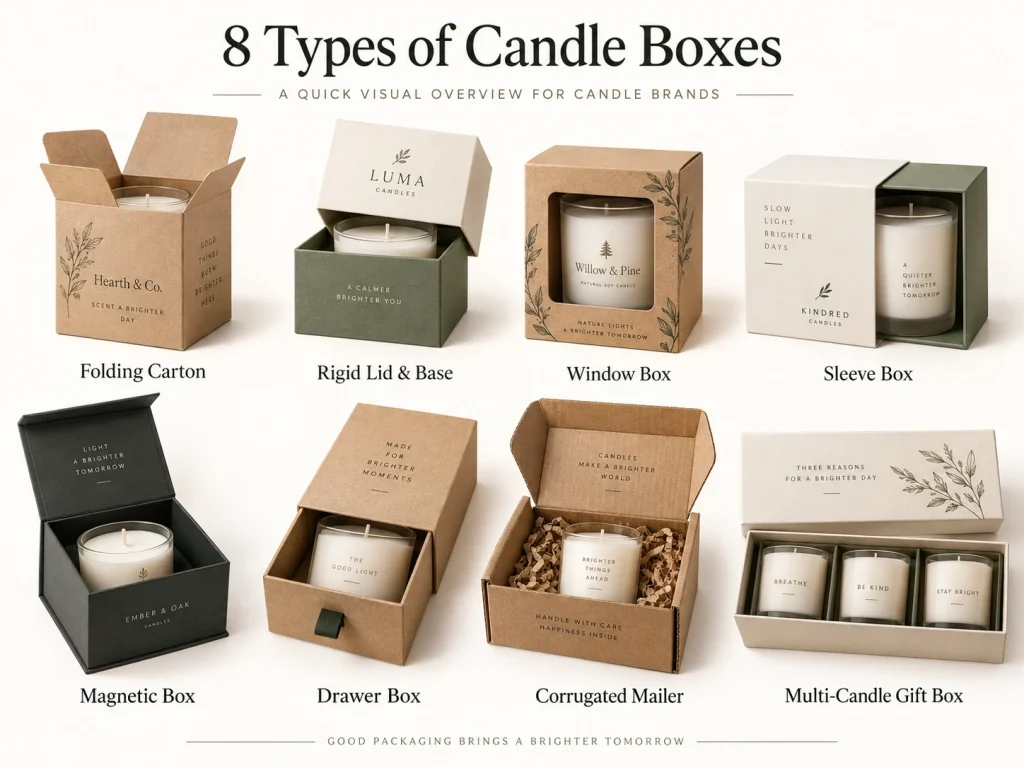
For brands comparing different types of custom candle boxes, the most common options include folding cartons, rigid lid-and-base boxes, window boxes, sleeves, magnetic boxes, drawer boxes, corrugated mailers and multi-candle gift boxes.
Each handles product weight, presentation, storage and shipping differently. The right choice usually comes down to the candle itself: dimensions, filled weight, jar material, selling price and how the product reaches the customer.
8 Types of Candle Boxes at a Glance
A quick comparison makes the differences easier to see.
| Candle Box Type | Best Suited For | Main Advantage |
|---|---|---|
| Folding Carton | Standard jars, tins, retail candles | Lightweight and economical |
| Rigid Lid & Base | Luxury glass candles | Premium presentation |
| Window Box | Decorative candles | Product visibility |
| Sleeve Box | Fragrance collections | Easy SKU variation |
| Magnetic Box | Premium gifts and launches | High-end unboxing |
| Drawer Box | Boutique gifts | Distinctive reveal |
| Corrugated Mailer | E-commerce orders | Shipping protection |
| Multi-Candle Gift Box | Sets and collections | Organized presentation |
Those differences become more important once glass weight, courier handling and production volume enter the picture.
1. Folding Carton Candle Boxes
For standard retail candles, folding cartons are often the most practical starting point.
They are usually made from paperboard, supplied flat and assembled during packing. That keeps warehouse space and inbound freight under better control, especially on larger runs.
The format works well for jar candles, tins, travel sizes, seasonal SKUs and everyday retail ranges. Full-color printing, foil details, embossing, matte lamination and die-cut windows can all be added without changing the basic structure.
Where folding cartons need more attention is strength.
A light candle tin is straightforward. A thick glass vessel filled with several hundred grams of wax is not.
Once the product becomes heavier, board thickness, bottom construction and internal fit matter. A loose-fitting carton around a heavy jar may look fine on a screen but perform poorly once the product is handled repeatedly in retail or transport.
For high-volume products where cost and storage efficiency matter, folding cartons remain one of the strongest options.
2. Rigid Lid-and-Base Candle Boxes
Premium candles often move into rigid packaging because the box becomes part of the product experience.
Unlike folding cartons, rigid candle boxes keep their shape. The thicker construction adds physical weight, creates a stronger presentation and gives brands more freedom to use fitted inserts, specialty paper, foil stamping, embossing and textured finishes.
One of the most familiar formats is the lid and base candle box. The separate lid lifts away from the base, creating a simple opening sequence that works particularly well for premium glass jars and gift products.
This style makes sense for higher-value scented candles, signature collections, limited editions and corporate gifting.
It does not automatically make sense for every candle.
Putting an elaborate rigid box around a low-cost promotional candle can push packaging cost too far. Around a premium jar intended as a gift, the same structure may feel completely appropriate.
The packaging should support the selling price rather than compete with it.
3. Candle Boxes with Windows
Some candles benefit from being seen before the box is opened.
Decorative wax, unusual jar colors, handmade finishes and sculptural candles can all gain from a window cut into the carton.
Strictly speaking, a window is more of a packaging feature than a separate structural family. In practice, though, customers often search for “candle boxes with windows” as a distinct style, so it deserves its own consideration.
A die-cut opening can reveal part of the jar, label or wax while the rest of the carton still provides branding space and protection. Clear film may be added behind the opening when additional separation is needed.
The design needs restraint.
Removing too much material from the front panel can reduce stiffness, especially around a heavy glass product. A large dramatic opening may look appealing in a render but leave less board around the jar.
For heavier candles, a smaller window combined with a well-fitted inner holder is often the better compromise.
4. Sleeve Candle Boxes
Sleeves become especially useful when one candle format is sold in several scents.
Instead of redesigning the entire box for every fragrance, the brand can keep one standard inner structure and change only the printed sleeve.
A collection might use the same jar and box dimensions for Lavender, Vanilla, Rose, Sandalwood and a seasonal Holiday scent. Each version receives different graphics while the structural dieline stays unchanged.
That can simplify SKU management significantly.
Sleeves generally work in two ways: one slides over a tray, while the other wraps around an existing carton or rigid box.
They also make sense for collaborations and limited editions. The underlying box can remain consistent while the outer sleeve carries the campaign-specific artwork.
For brands that frequently refresh graphics but rarely change candle dimensions, this approach can be much more efficient than developing a new box every time.
5. Magnetic Candle Boxes
Magnetic packaging is often used when the candle is being positioned as a gift rather than simply a retail item.
The hinged lid stays attached to the base and closes with concealed magnets. Opening the box creates a controlled reveal, while the inside lid provides a large surface for artwork, collection messaging or brand storytelling.
This works particularly well for luxury candle collections, seasonal gift sets, collaborations, PR packages and corporate gifting.
The structure becomes even more useful when several items belong in the same set.
A candle, matchbox and fragrance card, for example, can each sit in a dedicated compartment instead of moving loose inside the box.
The magnets are not really the main attraction. The value comes from the complete presentation: hinged opening, clean product arrangement and the ability to create a box that feels reusable rather than disposable.
6. Drawer Candle Boxes
Drawer boxes create a very different opening sequence.
Instead of removing a lid, the customer pulls an inner tray from an outer sleeve. That slower reveal can give a relatively small product more presence.
The format suits boutique candles, travel sets, candle-and-match combinations and smaller luxury collections.
Opening methods can stay simple. A ribbon pull works for more decorative packaging, while a thumb notch or paper tab keeps the design quieter.
One advantage is the division between the outer sleeve and inner tray.
The sleeve offers a clean branding surface. The tray handles product fit and support.
For a large everyday retail range, the added construction may not be necessary. For a limited collection or premium gift product, it can make the packaging feel much more deliberate.
7. Corrugated Candle Mailer Boxes
Candle brands selling online eventually run into an important distinction:
retail packaging and shipping packaging are not the same thing.
A folding carton that looks excellent on a shelf may offer limited protection once a glass jar enters a parcel network.
Courier shipments involve drops, vibration, stacking and repeated handling. That is where corrugated mailer boxes become useful.
The mailer may hold a finished presentation box, or it can become the branded packaging itself.
Some DTC brands use a layered system:
Candle jar → presentation box → protective corrugated mailer
Others place the candle directly into a printed mailer with a fitted insert or cushioning material.
Neither approach is automatically better.
A luxury candle may justify both presentation and shipping layers. A more accessible DTC brand may prefer one well-designed corrugated structure that handles branding and transit protection together.
The mistake is designing the retail box first and only thinking about shipping after production has already been finalized.
8. Multi-Candle Gift Boxes
Gift sets create a problem that single-candle packaging does not: glass jars can hit each other.
Two beautiful candles placed loose inside a box are still two heavy glass containers moving during handling.
Multi-candle packaging usually solves this with fitted compartments or dividers.
Typical sets might combine two or three candles, a candle and diffuser, a candle with matches, or a wider home-fragrance collection.
Insert materials vary according to weight and presentation. Paperboard partitions may be enough for lighter products. Corrugated dividers provide more structural support. Premium gift sets may use molded pulp, EVA or foam.
The main goal is simple: keep the products separated and correctly positioned.
An insert should not only look good when the lid opens. It should also prevent the jars from shifting into one another before the customer ever sees the box.
Candle Box Style vs. Candle Box Material
One common source of confusion is treating the box style and the box material as the same thing.
They are different decisions.
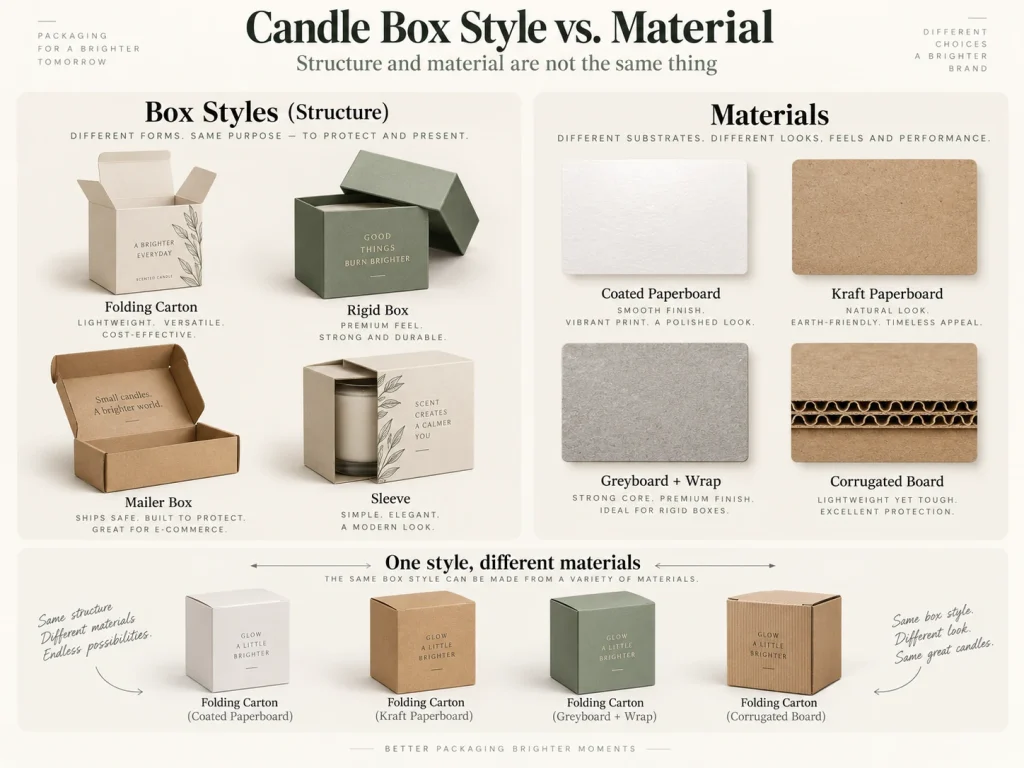
Style describes the structure.
A lid-and-base box, drawer box, sleeve, mailer and magnetic box all describe how the packaging is built and opened.
Material describes what that structure is made from.
| Box Style | Common Material Options |
|---|---|
| Folding Carton | Coated paperboard, kraft paperboard |
| Rigid Box | Greyboard wrapped with printed or specialty paper |
| Mailer Box | Corrugated board |
| Sleeve | Paperboard, kraft or specialty paper |
| Gift Box | Rigid board, folding board or corrugated board |
This matters when a buyer asks for a “kraft candle box.”
Kraft tells the manufacturer something about the material and visual direction, but it does not fully define the packaging.
The final structure could still be a folding carton, sleeve, mailer or another style entirely.
Which Candle Box Should You Choose?
The quickest way to narrow down the options is to start with the product rather than the packaging catalogue.
| Candle Product | Good Starting Point |
|---|---|
| Small candle tin | Folding carton |
| Standard glass jar | Folding carton with holder |
| Premium glass jar | Rigid lid-and-base box |
| Decorative pillar candle | Window carton |
| Luxury single candle | Rigid presentation box |
| Two- or three-candle set | Magnetic or rigid gift box |
| Multiple fragrance SKUs | Standard inner box + printed sleeve |
| DTC candle shipment | Corrugated mailer |
| Candle + diffuser set | Multi-product rigid box with insert |
These are starting points, not fixed rules.
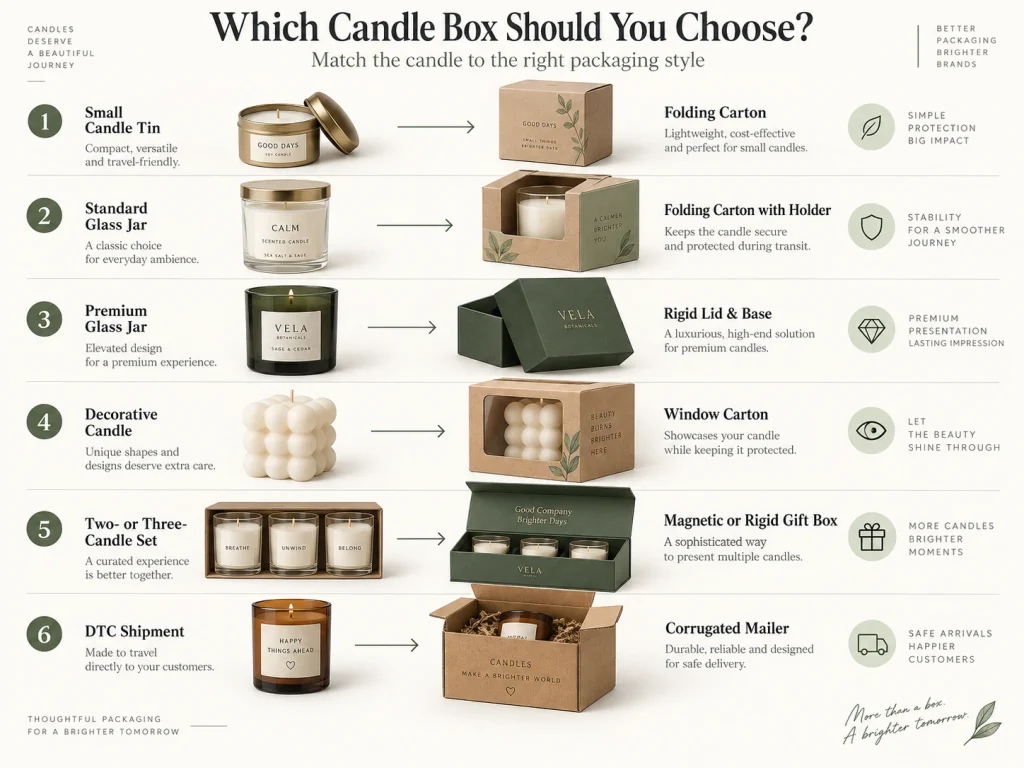
A premium DTC candle, for example, may use both a rigid presentation box and a corrugated shipping mailer.
Box structure is also only one part of the specification. If you are comparing materials, inserts, finishes, printing methods and purchasing considerations as well, our candle box buying guide covers those topics in more detail.
5 Things to Check Before Choosing a Candle Box
1. Candle Dimensions
Measure the finished product, not just the jar specification from the supplier.
Include the lid.
For round vessels, record diameter and total height. Square jars need width, depth and height.
A few millimeters can become important once inserts or close-fitting cartons are involved.
2. Filled Weight
An empty glass jar and a finished candle are not the same packaging load.
Wax, lid, decoration and accessories can add substantial weight. That affects board choice, base strength and the amount of internal support required.
3. Sales Channel
Retail and e-commerce put pressure on packaging in different ways.
Shelf packaging emphasizes presentation, footprint and customer visibility.
Parcel delivery places much more emphasis on impact, movement and compression.
4. Product Positioning
Packaging should make sense next to the retail price.
A $15 candle does not need to imitate the packaging of a $90 luxury fragrance candle. Likewise, a premium gift product can feel underdeveloped if the packaging looks like a basic shipping carton.
5. Shipping Method
Think beyond the box itself.
Will packaging arrive flat at your warehouse? Will rigid boxes be shipped fully assembled? How many finished units fit into a master carton? Will individual candles go through courier networks?
Those decisions affect cost long before the customer opens the box.
Frequently Asked Questions
What is the best type of box for candles?
There is no single best option. Folding cartons work well for standard retail candles, rigid boxes suit premium products and gift sets, while corrugated mailers are generally better suited to direct-to-consumer shipping.
Which box works best for a glass candle jar?
The answer depends heavily on filled weight. Standard jars can use folding cartons with suitable support, while heavier or more premium glass candles often benefit from rigid boxes and fitted inserts.
Are rigid boxes good for candles?
Yes. They work particularly well for luxury candle jars, gift products and premium collections where presentation and structural feel are important.
Can candle boxes have windows?
Yes. Die-cut windows are commonly used to reveal the jar, wax, label or decorative candle. Window size should still be balanced against the strength required by the product.
What is the difference between a rigid candle box and a folding carton?
Rigid boxes keep their shape and create a heavier, more premium presentation. Folding cartons use thinner paperboard, usually ship flat and tend to be more efficient for larger retail volumes.
What packaging is best for shipping candles?
Corrugated mailers or shipping cartons are generally better suited to parcel delivery. Heavy glass jars may also require dividers, fitted inserts or additional cushioning.
Do candle boxes need inserts?
Not always. Lightweight products inside close-fitting cartons may not need them. Heavy glass jars, multi-candle sets and luxury gift packaging often benefit from inserts for both protection and presentation.
What materials are commonly used for candle boxes?
Common choices include coated paperboard, kraft paperboard, rigid greyboard with paper wrapping and corrugated board. Material selection should follow the structure, product weight, appearance and sales channel.
Need Custom Packaging for Your Candle?
MailingBoxFactory develops custom candle packaging for retail candles, luxury gift sets, multi-candle collections and direct-to-consumer shipping.
Depending on the product, the final solution might use a folding carton, rigid box, magnetic gift box, custom insert or protective corrugated mailer.
Send us your candle dimensions, filled weight, required quantity, preferred box style, artwork and destination country. Product photos or a reference box are also useful if you already have them.
We can review the project and recommend a structure that makes sense for the product rather than forcing the candle into a standard box.
Not sure which candle box style fits your product? Send us your candle dimensions, filled weight and product photos for a packaging recommendation.