“How long will it take?” is the first question nearly every buyer asks, and the most consequential one to get wrong. A product launch, a seasonal campaign, or a retail placement date does not move because the boxes arrived late. Yet packaging timelines slip constantly — not because manufacturing is unpredictable, but because buyers plan around a single number (“production takes about two weeks”) while the real lead time has three distinct stages, each with its own clock.
Those three stages are sampling, bulk production, and delivery. Each one is gated by the one before it: production cannot start until you approve the sample, and delivery cannot start until production finishes and passes inspection. Understanding what happens inside each stage — and what typically goes wrong — is how you build a launch plan your packaging will not break.
This guide breaks down realistic timelines for each stage, explains what drives them longer or shorter, lists the most common delay causes, and walks through a worked example of planning backwards from a launch date.
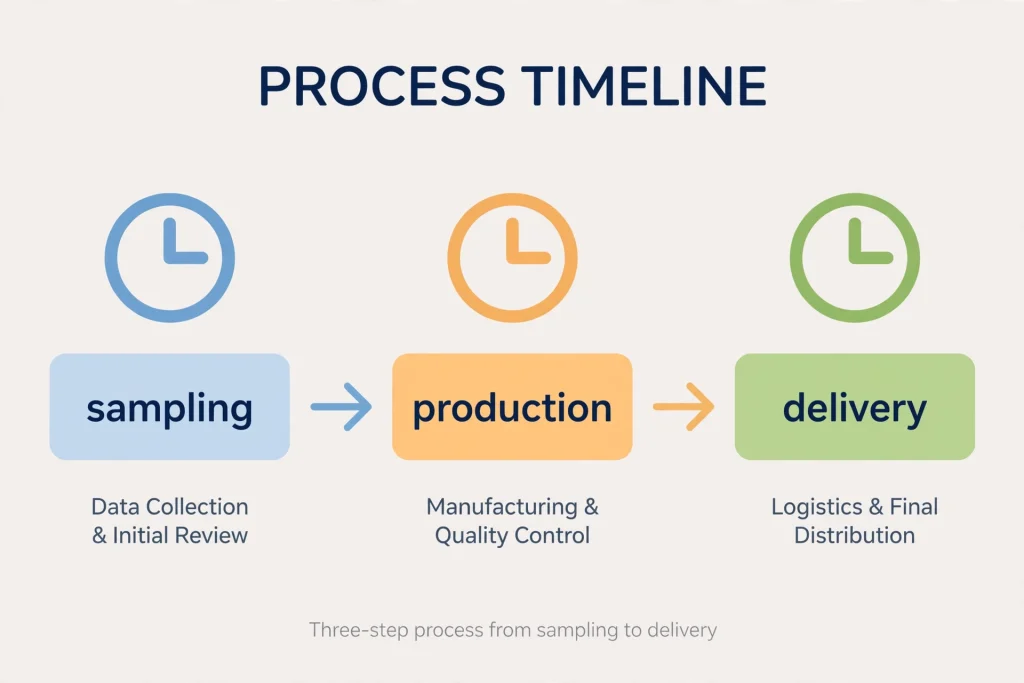
The Three Stages at a Glance
Before going deeper, here is the complete picture in one table. All durations below are typical ranges for custom paper packaging boxes ordered from an overseas manufacturer; your specific project may land anywhere within them.
| Stage | Typical Duration | What Happens |
|---|---|---|
| 1. Sampling | 3–7 days | Structural sample and/or printed proof made, shipped to you, checked and approved |
| 2. Bulk production | 15–20 days after sample approval | Printing, finishing, die-cutting, assembly, quality inspection, packing |
| 3. Delivery | Air freight 7–10 days; sea freight several weeks (varies by lane) | International shipping plus customs clearance |
Two things to notice. First, the production clock starts at sample approval, not at order placement — the sampling stage is on the critical path, not a preliminary you can overlap. Second, “15–20 days production” plus shipping means the realistic door-to-door range for most custom box projects is roughly five to nine weeks from first artwork to delivered cartons. Plan with that number, not with the production figure alone.
Stage 1 — Sampling: 3–7 Days That Protect the Whole Order
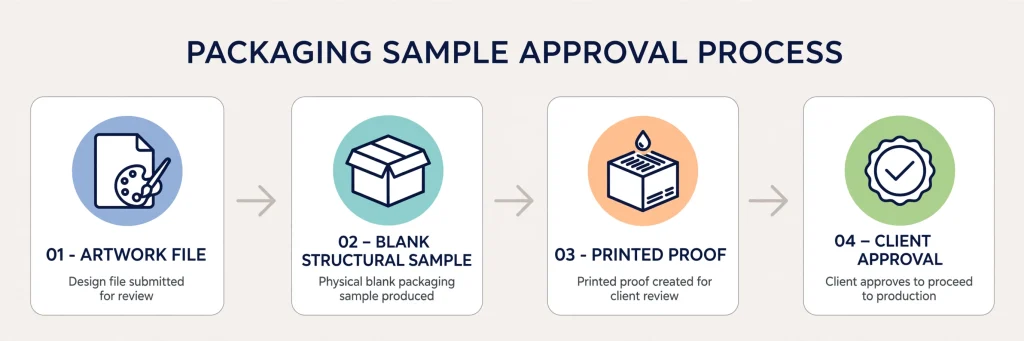
Sampling is the cheapest insurance in packaging procurement. courier fee now prevent a full production run of boxes that do not fit, do not match your colors, or do not survive assembly. Professional buyers never skip it, and neither should you.
There are two main types of samples, and they answer different questions:
Blank structural samples are unprinted boxes made in the actual board and structure you specified. They answer physical questions: Does the product fit? Does the tuck flap hold? Does the rigid box lid sit correctly? Does the insert cradle the bottle? These are typically provided free of charge — you only cover the courier cost — and they are the fastest way to validate structure.
Printed proofs (also called pre-production samples) carry your actual artwork, colors, and finishes. They answer visual questions: Is the red on-brand? Is the foil registration clean? Does the emboss read clearly? Printed proofs take longer and may carry a sampling fee, since they require platemaking and press setup.
What to check when a sample arrives: dimensions against your product (with real product in hand, not a spec sheet), board stiffness and thickness, print color accuracy under normal lighting, finish quality (lamination smoothness, foil edges, emboss depth), glue joint strength, and — for rigid boxes — the fit between components like lids, trays, and inserts. For a detailed checklist of sample types and what to look for, see our guide on which packaging sample to order before bulk production.
The most important rule of sampling: nothing in bulk production starts until you give written approval. That approval is also your last comfortable moment to request changes. Revisions after approval mean re-sampling, and the clock restarts.
Stage 2 — Bulk Production: 15–20 Days After Sample Approval
Once your sample is approved, the production clock starts. The typical 15–20 day window covers the full manufacturing sequence for custom paper boxes:
- Prepress and tooling — artwork is finalized to the approved proof, printing plates are made, and the cutting die is prepared from the dieline. If you are unfamiliar with dielines, our dieline guide explains what your manufacturer needs from your design files.
- Printing — offset litho for most custom box runs; the printed sheets are checked against the approved proof for color.
- Surface finishing — lamination, foil stamping, embossing, spot UV, and other finishes are applied. Each finish is an additional pass, which is why heavily finished boxes sit at the longer end of the range.
- Die-cutting and creasing — sheets are cut and scored to the dieline.
- Gluing and assembly — folding cartons are folded and glued; rigid boxes are wrapped, formed, and assembled (largely by hand, which is why rigid construction takes longer than folding cartons of similar size).
- Quality inspection and packing — finished boxes are inspected against the approved sample, then packed flat or assembled into export cartons.
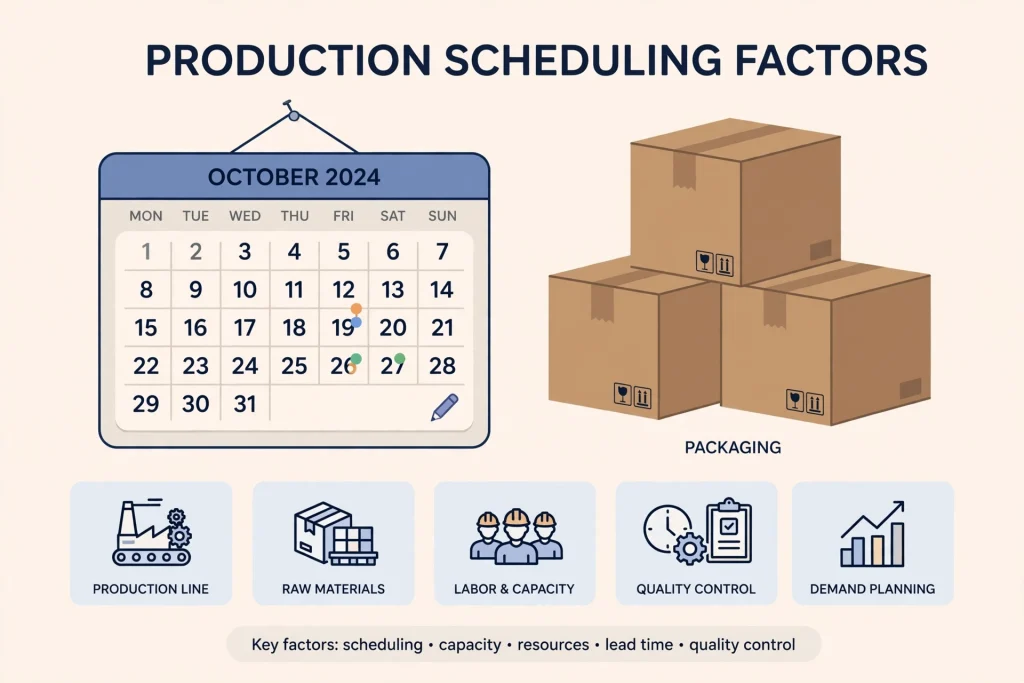
Several factors move a project toward the shorter or longer end of the 15–20 day window:
- Artwork readiness. Print-ready files built correctly on the dieline sail through prepress. Files that need fixing, missing fonts, or low-resolution images stall the very first step.
- Material availability. Standard boards and papers are stock items; specialty papers, unusual board thicknesses, or custom-dyed stocks may need to be ordered in.
- Finishing complexity. A CMYK folding carton with matte lamination is a fast job. The same carton with foil stamping, embossing, and spot UV is three additional processes with drying and setup time between them.
- Box structure. Folding cartons run largely on automated lines. Rigid boxes involve significant hand assembly — wrapping, corner folding, insert fitting — so expect rigid projects to use the full window.
- Order quantity. Larger runs need more press time and more assembly hours. Quantity also interacts with MOQ considerations: very small runs may be grouped with other jobs, which can affect scheduling.
Stage 3 — Delivery: Air, Sea, or Express
Finished boxes still have to reach you, and the shipping method you choose is a direct trade-off between speed and cost.
Express courier (DHL, FedEx, UPS) takes roughly 3–5 days door to door and is the standard choice for samples and urgent small batches. It is priced by chargeable weight, so it becomes expensive quickly for full carton quantities.
Air freight typically takes 7–10 days including handling at both ends. It suits medium-size orders and time-sensitive launches where sea freight would miss the date. The cost per unit sits well below express courier but well above sea freight.
Sea freight takes several weeks, with the exact duration varying by shipping lane, port pair, and whether your cargo fills a container or shares one (LCL). It is by far the most economical option for large orders and the default for planned, non-urgent replenishment. Because the range is wide and lane-dependent, always ask your forwarder for the current schedule on your specific route rather than relying on a rule of thumb.
One often-forgotten line item: customs clearance. Standard commercial shipments clear routinely, but clearance still takes days, not hours, and incomplete paperwork — wrong HS codes, missing invoices, undeclared wood packaging — stops it cold. Confirm document requirements with your freight forwarder before the goods sail, not after they arrive.
What Causes Delays (and How to Avoid Them)
Across hundreds of custom packaging projects, the same delay causes recur. None of them are mysterious, and all of them are preventable:
| Delay Cause | How to Avoid It |
|---|---|
| Artwork revisions after proof approval | Freeze artwork before sampling; route internal approvals before, not during, production |
| Slow sample approval | Assign one decision-maker; check the sample against a written checklist on arrival day |
| Changing materials or finishes mid-order | Lock specifications at sample approval; treat post-approval changes as a new timeline |
| Underestimating finishing time | Ask your manufacturer for a process-by-process breakdown when finishes are complex |
| Peak-season congestion | Add 1–2 weeks buffer for orders shipping in the pre-holiday rush (roughly Sept–Nov) |
| Customs paperwork errors | Confirm HS codes and invoice details with your forwarder before shipment |
The pattern is clear: almost every delay originates on the buyer’s side of the table — in artwork, approvals, or specification changes — not on the factory floor. The buyers with the smoothest timelines are not the ones with the simplest boxes; they are the ones who make decisions quickly and stop changing them. Choosing an experienced partner matters here too — our guide on how to find a reliable custom packaging manufacturer in China covers what to evaluate beyond price.
Planning Backwards: A Worked Example
The reliable way to plan is to start from your must-hit date and subtract each stage, adding a buffer. Here is a worked example for a product launching December 1:
- Delivery buffer: Allow 1 week for customs clearance and domestic handling after the goods land. → Goods must arrive by November 24.
- Stage 3 — sea freight: Assume several weeks port to port on your lane (confirm with your forwarder; here we use 4 weeks as a planning figure). → Goods must ship by October 27.
- Stage 2 — production: Use the conservative end of the range, 20 days, plus a few days for inspection and export packing. → Sample must be approved by October 3.
- Stage 1 — sampling: Allow 7 days for the sample plus a few days for courier transit each way and your internal review. → Start sampling by mid-September.
So for a December 1 launch via sea freight, first contact with your packaging manufacturer should happen in early September — roughly 11–12 weeks out. If that feels early, consider what happens without it: every week of delay in sampling compresses directly into your shipping options, and the fallback is air freight at several times the cost.
For an air-freight plan, the same exercise compresses: 10 days for air plus buffer, 15–20 days production, 7 days sampling — roughly 6–7 weeks from first contact to delivered boxes. Either way, the math only works if you do it before you need it.
Frequently Asked Questions
How long does packaging sampling take?
Typically 3–7 days to produce the sample, plus courier transit time each way. Blank structural samples are usually at the faster end; printed proofs requiring platemaking take longer. Your review time is part of the stage too — approve promptly against a checklist to keep the timeline moving.
When does the production clock actually start?
At your written approval of the final sample — not at order placement, deposit payment, or artwork submission. Any specification change after approval restarts sampling, so treat approval as a formal gate.
Can production be rushed?
Sometimes, but within limits. Simple folding-carton jobs with stock materials and CMYK-only printing have the most flexibility. Rigid boxes with hand assembly, complex finishing, or specialty materials have hard physical limits — there are only so many hours of handwork in a day. If timing is critical, simplify the specification (fewer finishes, stock board) rather than asking the factory to compress physics.
Should I choose air or sea freight for my boxes?
Choose by deadline and order size. Sea freight is the economical default for large, planned orders — allow several weeks and confirm the lane schedule. Air freight (typically 7–10 days) suits medium orders with firm launch dates. Express courier is for samples and emergencies only; it is never economical for bulk quantities.
What is the single most common cause of packaging delays?
Late or repeatedly revised artwork approval. Most timeline slips trace back to the buyer’s side: design changes after proofing, slow sample sign-off, or specification changes mid-production. Freezing artwork early and assigning a single decision-maker prevents more delays than any factory-side measure.
If you have a launch date in mind, work backwards through the three stages and contact us with your target timeline — we will tell you honestly whether your schedule is comfortable, tight, or needs a rethink before you commit.