
Perfume packaging carries a heavier burden than almost any other box its size. The bottle inside is glass, often heavy, frequently irregularly shaped, and always expensive relative to its size. The box must protect it through shipping, present it as a luxury object, and do both at dimensions where every millimeter matters.
Getting perfume box size right starts with the bottle — its height, its footprint, its weight, and whether the cap stays on in the box. This guide provides standard size ranges for common bottle formats, explains how to measure correctly, and covers the insert and construction decisions that make a small box survive a long journey.
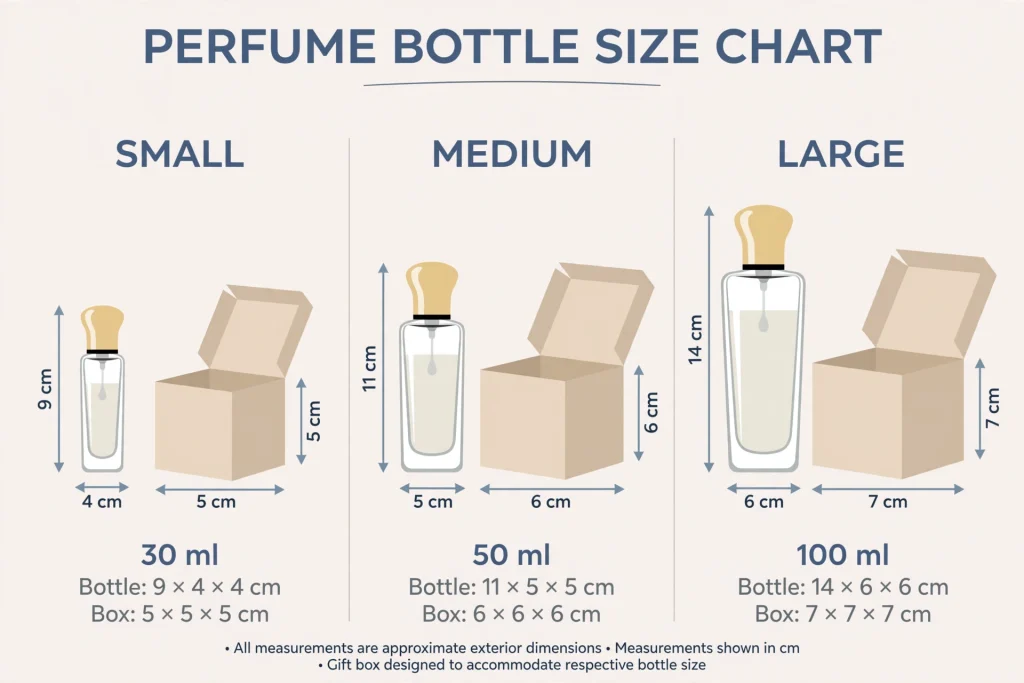
Perfume Box Size Chart: Standard Dimensions by Bottle Type
Typical box dimensions (length × width × height) for common perfume bottle formats. These are industry-typical ranges, not fixed specifications — bottle designs vary enormously, so always measure your actual bottle and confirm with a physical sample.
| Bottle Format | Typical Bottle Size | Typical Box Dimensions (in) | Typical Box Dimensions (cm) |
|---|---|---|---|
| Travel spray / mini (10–15 ml) | ~1″ × 0.75″ × 3″ H | 1.5 × 1.25 × 3.5 | 3.8 × 3.2 × 8.9 |
| Standard rectangular (30 ml / 1 oz) | ~1.75″ × 1.25″ × 3.75″ H | 2.25 × 1.75 × 4.5 | 5.7 × 4.4 × 11.4 |
| Standard rectangular (50 ml / 1.7 oz) | ~2″ × 1.5″ × 4.25″ H | 2.5 × 2 × 5 | 6.4 × 5.1 × 12.7 |
| Standard rectangular (100 ml / 3.4 oz) | ~2.5″ × 1.75″ × 4.75″ H | 3 × 2.25 × 5.5 | 7.6 × 5.7 × 14 |
| Cylindrical bottle (50 ml) | ~1.75″ dia × 4.5″ H | 2.25 × 2.25 × 5.25 | 5.7 × 5.7 × 13.3 |
| Cylindrical bottle (100 ml) | ~2″ dia × 5″ H | 2.5 × 2.5 × 5.75 | 6.4 × 6.4 × 14.6 |
| Flat / flask bottle (50 ml) | ~2.5″ × 1″ × 4″ H | 3 × 1.5 × 4.75 | 7.6 × 3.8 × 12.1 |
| Oversized / sculptural | varies widely | measure + 0.5″ clearance | measure + 1.25 cm clearance |
Box dimensions include roughly 0.25–0.5″ (6–12 mm) of clearance per side beyond the bottle — room for the insert and easy insertion. Perfume boxes run snugger than candle boxes: a rattling perfume bottle is a breakage risk, so the insert takes up the slack rather than empty air.
Note the 100 ml rectangular format especially: at around 3 × 2.25 × 5.5″, it is the most common custom perfume box size in the industry, and the one most worth optimizing if you are launching a standard line.
How to Measure Your Bottle
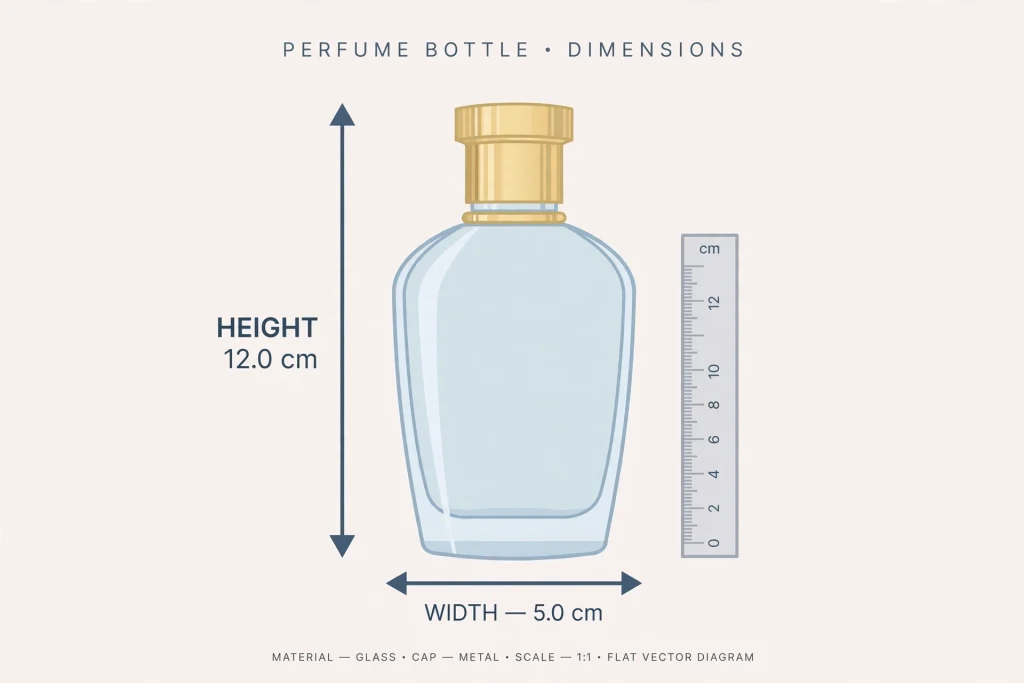
Perfume bottles punish sloppy measurement more than most products, because the boxes are small and the bottles are irregular. Measure carefully:
- Height with the cap on. The cap is part of the product as received. Decorative caps — heavy glass stoppers, metal magnetic caps — often add significant height and weight. Measure the assembled bottle.
- Maximum width and depth. For rectangular bottles, measure both footprint dimensions. For cylindrical bottles, measure the diameter at the widest point (often the base or the shoulder, not the middle).
- Weight the filled bottle. A 100 ml glass flacon can weigh several hundred grams filled. Weight drives the insert and board decision — a heavy bottle in a light insert will punch through in transit.
- Check the silhouette. Sculptural bottles, protruding sprayers, attached charms, or asymmetric designs create maximum dimensions that a “bottle size” spec sheet will not show. Measure the actual extremes.
- Decide: cap on or cap off in the box? Most brands ship with the cap on, but some place the cap beside the bottle in a fitted insert. This changes the height requirement — decide before sizing.
Our general guide on how to measure a box covers the L×W×H ordering convention used throughout this chart.
Choosing the Right Insert
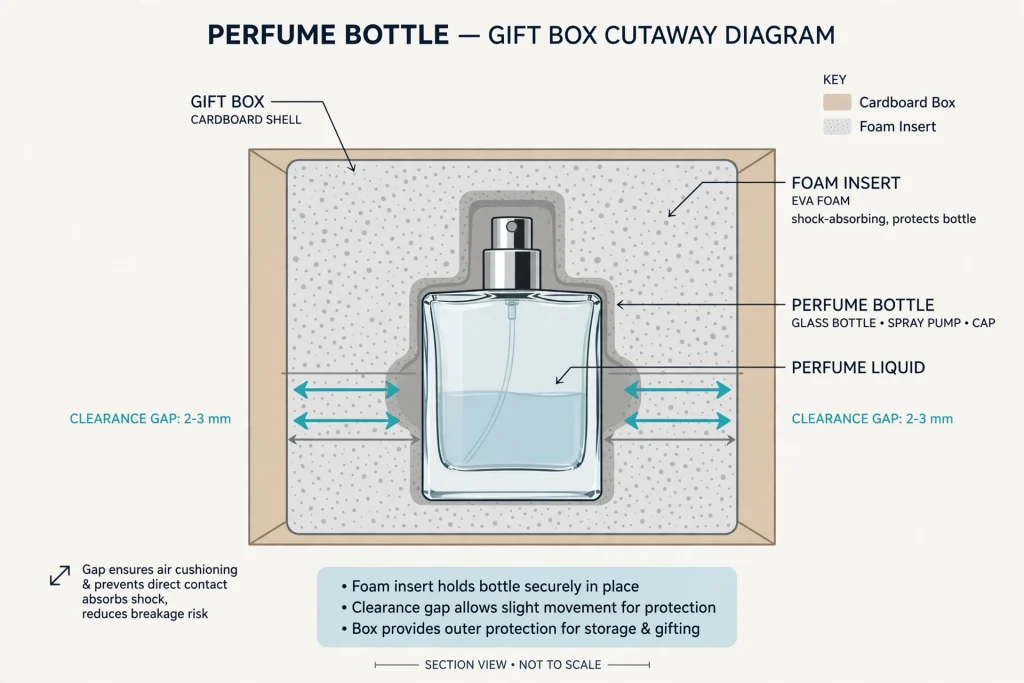
For perfume, the insert is not optional — it is the component that does the actual protecting. The box provides structure and presentation; the insert immobilizes the glass. Common options:
Die-cut paperboard inserts are the standard for most perfume boxes: a folded or flat die-cut piece that cradles the bottle’s base and neck. They are economical, recyclable, and print well. Best for standard rectangular and cylindrical bottles in folding-carton or rigid boxes.
Molded pulp inserts fit irregular bottle shapes better than flat die-cuts and offer good cushioning. They suit brands with a sustainability story, though the aesthetic is utilitarian — usually hidden inside a rigid box.
EVA foam inserts provide the most precise, premium-feeling fit — the bottle sits in a cavity cut to its exact silhouette. Common in high-end fragrance where the unboxing is part of the product. Foam complicates recyclability claims, so weigh that against the positioning.
Satin or velvet lining over a rigid insert adds a luxury touch for gift-oriented fragrances. It is a finishing detail, not a protective one — pair it with a structural insert underneath.
The insert decision interacts with box size directly: a thicker insert needs a larger box. Finalize the insert concept before locking box dimensions, and always test with the filled bottle — an empty bottle weighs a fraction of the real thing and tells you nothing about transit survival. Our gift box inserts guide compares the materials in detail.
Rigid Box vs Folding Carton for Perfume
The construction decision shapes both protection and positioning:
| Factor | Rigid Box | Folding Carton |
|---|---|---|
| Protection for glass | Excellent — thick walls plus insert | Good — needs a well-designed insert |
| Luxury perception | High — weight and structure signal premium | Medium — depends on print and finishing |
| Typical cost | Higher (materials + hand assembly) | Lower |
| Best for | 50–100 ml signature fragrances, gift sets | Discovery sets, minis, samples, secondary packaging |
| Finishing | Foil, embossing, soft-touch, magnetic closure | Full-color print, foil, spot UV |
Most prestige fragrances use rigid boxes; most mass and DTC fragrances use folding cartons. Either can work — the insert quality matters more than the wall construction for actual breakage prevention. For more on matching construction to positioning, see our perfume packaging boxes guide.
Board Weight & Finishing Notes
Perfume boxes are small, so board choices behave differently than in larger packaging:
- Folding cartons: 350–400 gsm is the typical range — enough stiffness for a small box to feel substantial. Our paper GSM chart has the full breakdown.
- Rigid boxes: 1200–2000 gsm greyboard wrapped in printed paper is standard; the wrap carries the branding.
- Finishing: foil stamping, embossing, and soft-touch lamination are the classic fragrance finishes. On small boxes, one well-executed finish beats three crowded ones — restraint reads as luxury.
One caution: dark, heavily finished small boxes show scuffing in transit. If the perfume box is also the shipping box (common in DTC), consider a plain outer shipper — the unboxing moment is worth protecting.
Frequently Asked Questions
What size box fits a 100 ml perfume bottle?
A typical 100 ml rectangular bottle fits a box around 3 × 2.25 × 5.5 inches (7.6 × 5.7 × 14 cm), including clearance for an insert. Bottle designs vary widely, so measure your actual bottle with its cap on and confirm with a physical sample.
What size box fits a 50 ml perfume bottle?
Around 2.5 × 2 × 5 inches (6.4 × 5.1 × 12.7 cm) for a standard rectangular 50 ml bottle. Cylindrical 50 ml bottles need a squarer box — roughly 2.25 × 2.25 × 5.25 inches.
Do perfume boxes need inserts?
Yes — for glass bottles, an insert is essential, not optional. The insert immobilizes the bottle so it cannot strike the box walls in transit. Die-cut paperboard suits most standard bottles; EVA foam fits irregular or luxury designs.
Rigid box or folding carton for perfume?
Rigid for prestige positioning and maximum protection; folding carton for discovery sets, minis, and cost-sensitive lines. Insert quality affects breakage prevention more than wall construction does.
How do I keep a heavy glass bottle from breaking in transit?
Three things: a fitted insert that immobilizes the bottle, a snug box with minimal empty space, and — for DTC shipping — a plain outer shipper so the retail box never takes courier impacts directly. Test with filled bottles, not empties.
Sizing a fragrance line? Contact us with your bottle dimensions (footprint, height with cap, filled weight) and we will recommend box dimensions, construction, and insert — then provide a blank structural sample (free sample, you cover the courier) to verify the fit before production.