
A candle box that fits properly protects the product, photographs well, and costs less to ship. A box that is too loose wastes board, freight, and shelf presence; a box that is too tight risks breakage and frustrating unboxing. Getting the size right is one of the highest-leverage decisions in candle packaging — and it starts with knowing the standard size ranges for your candle type.
This guide provides a practical candle box size chart covering jar candles, tins, pillars, and tealights, explains how to measure your candle correctly, and walks through the packaging decisions that interact with size: box style, board weight, inserts, and shipping.
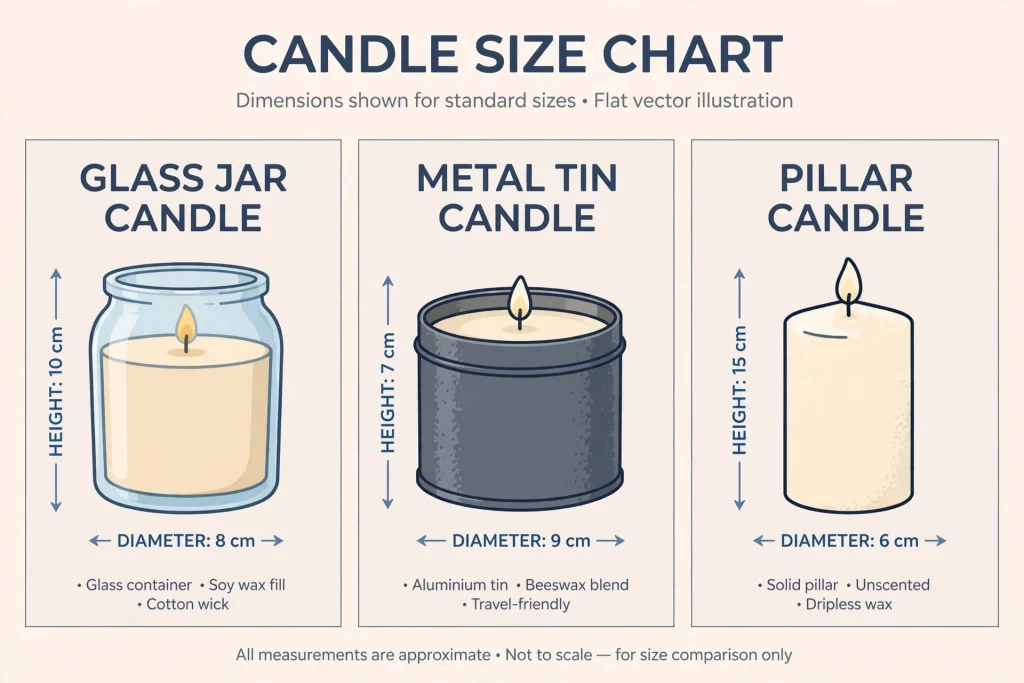
Candle Box Size Chart: Standard Dimensions by Candle Type
The chart below gives typical box dimensions (length × width × height, in inches and centimeters) for common candle formats. These are industry-typical ranges based on standard product sizes — not fixed specifications. Always measure your actual product and confirm with a physical sample before ordering, since candle dimensions vary significantly between brands.
| Candle Type | Typical Candle Size | Typical Box Dimensions (in) | Typical Box Dimensions (cm) |
|---|---|---|---|
| Small jar candle (4 oz) | ~2.75″ dia × 3″ H | 3 × 3 × 3.5 | 7.6 × 7.6 × 8.9 |
| Medium jar candle (8 oz) | ~3″ dia × 3.5″ H | 3.25 × 3.25 × 4 | 8.3 × 8.3 × 10.2 |
| Large jar candle (12–14 oz) | ~3.5″ dia × 4″ H | 3.75 × 3.75 × 4.5 | 9.5 × 9.5 × 11.4 |
| Apothecary / large jar (16–20 oz) | ~4″ dia × 5″ H | 4.25 × 4.25 × 5.5 | 10.8 × 10.8 × 14 |
| Small candle tin (4 oz) | ~3″ dia × 1.75″ H | 3.25 × 3.25 × 2.25 | 8.3 × 8.3 × 5.7 |
| Large candle tin (8 oz) | ~3.5″ dia × 2.25″ H | 3.75 × 3.75 × 2.75 | 9.5 × 9.5 × 7 |
| Pillar candle (3 × 4″) | 3″ dia × 4″ H | 3.5 × 3.5 × 4.5 | 8.9 × 8.9 × 11.4 |
| Pillar candle (3 × 6″) | 3″ dia × 6″ H | 3.5 × 3.5 × 6.5 | 8.9 × 8.9 × 16.5 |
| Tealight set (4-pack) | varies | 4 × 4 × 2 | 10.2 × 10.2 × 5.1 |
| Wax melts / clamshell | varies | 4 × 3 × 1.5 | 10.2 × 7.6 × 3.8 |
A few notes on reading this chart. First, box dimensions include a small clearance allowance (roughly 0.25″ / 6 mm per side) beyond the candle itself — enough for easy insertion without a loose rattle. Second, round candles in square boxes is the standard approach; the corners provide the clearance. Third, these ranges assume common product sizes. If your candle is unusually tall, wide, or heavy, treat the chart as a starting point and measure.
How to Measure Your Candle for a Box
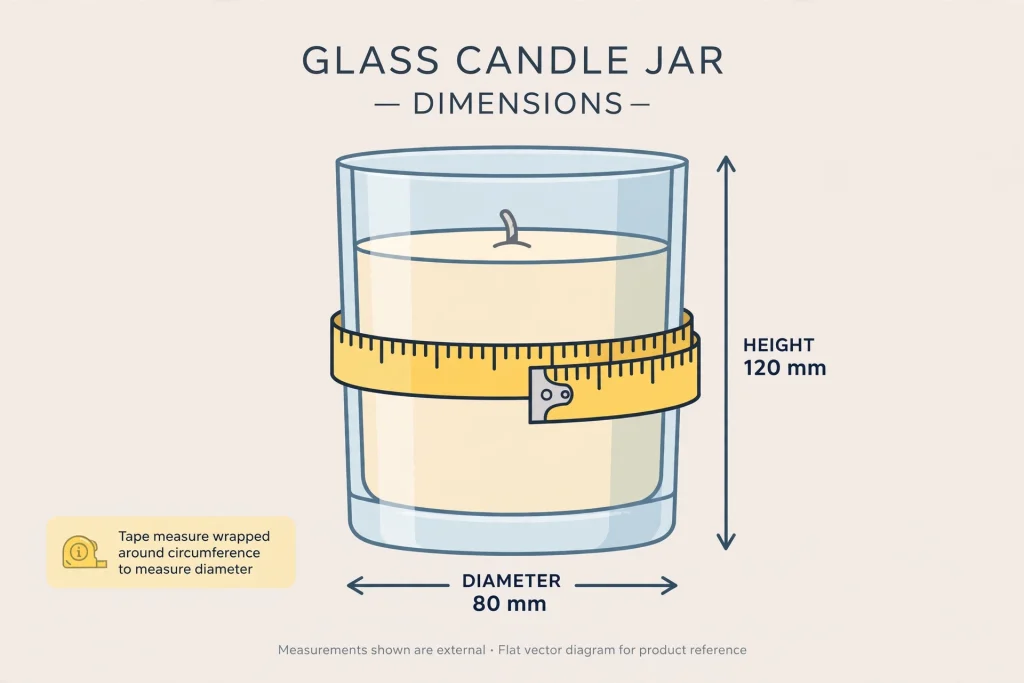
Correct measurement is the foundation everything else rests on. Our guide on how to measure a box covers the L×W×H convention; here is the candle-specific version:
- Measure the candle’s widest diameter. For jar candles and tins, measure straight across the widest point — usually the body, but check the lid if it overhangs.
- Measure total height with the lid on. The box must fit the candle as the customer receives it. Include lids, dust covers, and any decorative elements.
- Note the weight. A 4 oz tin and a 20 oz apothecary jar need different board weights even at similar diameters. Weight drives the board decision more than size does.
- Add clearance. Add approximately 0.25″ (6 mm) per side for easy insertion, plus a little more if you plan an insert or tissue wrap.
- Check for irregularities. Handles, wooden lids that overhang, labels that add thickness, or textured glass that is wider than it looks — measure the actual maximums, not the nominal size.
The most common measuring mistake is measuring the candle without its lid, then discovering the boxed height is half an inch short. The second most common is measuring one unit and assuming the whole production run matches — glass jars vary, so measure several units and size for the largest.
Box Styles for Candles (and When to Use Each)
Size and style interact: the right style at the wrong size fails just as surely as the wrong style.
Tuck-end folding cartons are the workhorse for jar candles and tins up to about 12 oz. They are economical, print beautifully, ship flat, and assemble quickly. For most DTC candle brands, this is the default choice. Compare closure options in our straight tuck vs reverse tuck guide.
Rigid boxes suit luxury candles, gift sets, and heavy jars where the box itself is part of the product experience. A rigid box adds presence and protection but also cost and freight volume — reserve it for candles where the price point supports it.
Sleeves over jars (a printed paperboard sleeve around a lidded jar) are a lighter option for brands that want branding without a full box. They work when the jar itself is presentable and the shipping protection comes from the outer mailer.
Window boxes let customers see the candle color and texture — valuable for retail, where the visual sells. The window film adds cost and complicates recycling claims, so weigh the retail benefit honestly.
Multi-packs and gift sets need dividers or fitted inserts. A set of three votives rattling in one box arrives broken; the same set in a die-cut insert arrives as a gift.
For shipping-focused guidance, see our guide on how to package candles for shipping.
Candle Tins & Travel Candles
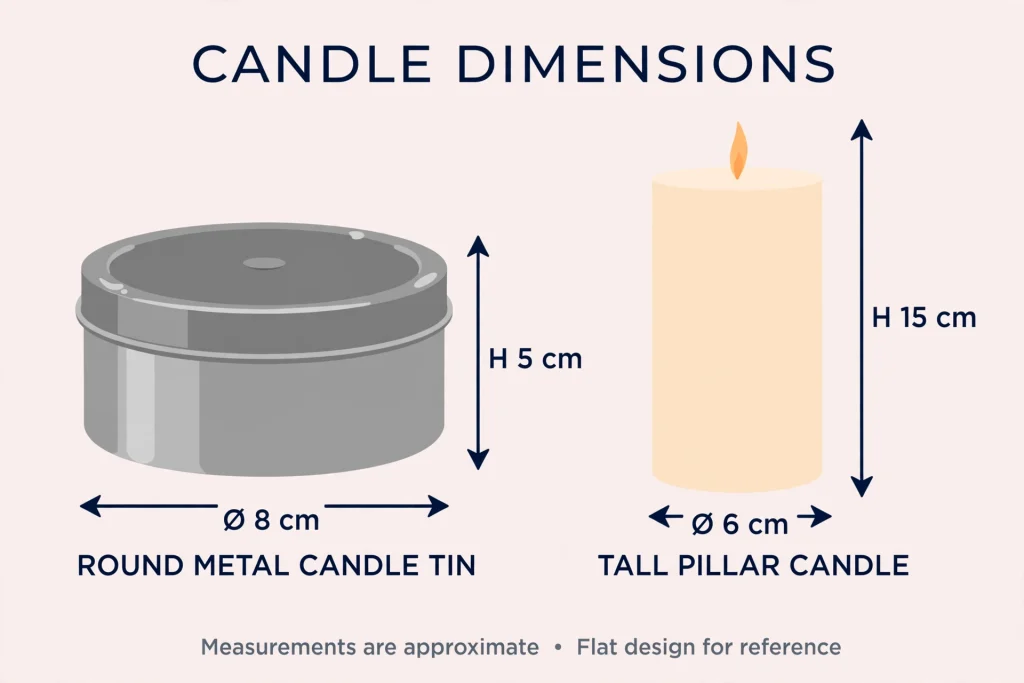
Tins deserve a special note because their proportions differ from jars: wide, short, and light. A tin box is typically only 0.25–0.5″ taller than the tin itself — excess height is the most common sizing error with tins, and it makes the box feel empty.
Travel candle sets (2–4 tins in one box) need an insert or divider — tins sliding against each other dent and scratch. Size the outer box to the insert layout, not to the tins individually: lay out the tins in their final arrangement, measure the footprint, and add clearance once.
Pillar candles, by contrast, are tall and heavy for their footprint. Their boxes need sturdier board (see below) and a snug fit — a tall pillar leaning in an oversized box is a breakage risk, since the leverage of the height works against the glass or wax.
Board Weight, Inserts & Shipping Considerations
Size determines the box; weight determines the board. As a starting point:
- Light candles (tins, tealights, wax melts): 300–350 gsm folding carton board is usually sufficient.
- Medium jars (8–12 oz): 350–400 gsm, or corrugated mailer-box style construction for shipping.
- Heavy jars (16 oz+) and tall pillars: rigid box construction or E/B-flute corrugated; folding carton alone may feel flimsy.
Our paper GSM guide explains how board weight translates to stiffness and which weights suit which box types.
Inserts serve two purposes: protection and presentation. For candles, a simple die-cut paperboard insert or corrugated divider usually suffices — full foam inserts are rarely necessary and complicate sustainability claims. If the candle ships in the same box it sells in (common for DTC), the box must do double duty: presentable on the doorstep and protective in the truck. That usually means a sturdier board choice than a retail-only box would need.
Finally, remember dimensional weight: an oversized box does not just waste board, it inflates shipping cost. Our guide to dimensional weight explains how carriers price the box size itself.
Frequently Asked Questions
What size box do I need for an 8 oz candle?
A typical 8 oz jar candle (about 3″ diameter × 3.5″ tall) fits a box around 3.25 × 3.25 × 4 inches (8.3 × 8.3 × 10.2 cm), including clearance. Measure your actual jar with its lid on — dimensions vary between brands — and confirm with a physical sample before ordering.
Should candle boxes be square or round?
Square boxes are the industry standard even for round candles. They are cheaper to produce, easier to print, ship flat efficiently, and stack well. Round rigid boxes exist but cost significantly more and are reserved for luxury positioning.
How much bigger should the box be than the candle?
Roughly 0.25″ (6 mm) of clearance per side is a good starting point — enough for easy insertion without rattling. Add more if you use an insert, tissue wrap, or shredded fill. Confirm the final fit with a physical sample using your actual product.
What board weight is best for candle boxes?
It depends on weight more than size: 300–350 gsm for tins and tealights, 350–400 gsm for medium jars, and rigid or corrugated construction for heavy jars and tall pillars. See our paper GSM chart for the full breakdown.
Do I need an insert in my candle box?
For single jars in a well-fitted box, usually not. For sets, tins that could slide, or candles shipping long distances in the retail box, a die-cut paperboard insert or divider is cheap insurance against breakage and a visibly better unboxing.
If you are sizing a candle line and want a second opinion, contact us with your candle dimensions (diameter, height with lid, weight) and quantities. We will recommend a box size, style, and board — and provide a blank structural sample (free sample, you cover the courier) so you can check the fit with your actual product before committing.